
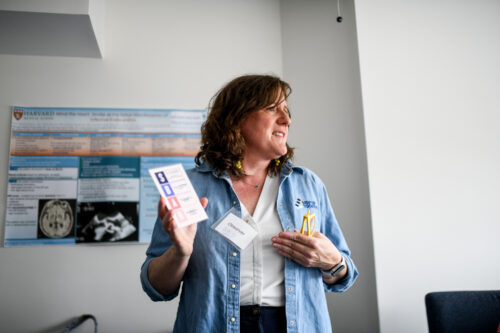
For Amy Romano (SOM ’15, YSN ’04), few things are as special as childbirth—an intimate experience shared by women throughout history yet deeply influenced by cultural and political attitudes. Romano had been drawn to social issues from an early age, and her interest in maternity care was sparked during her undergraduate years at the University of Michigan. Through interdisciplinary coursework in economics and women’s health, she found herself captivated by the experience of childbirth. One lecture on midwifery, which provides comprehensive, patient-centered care through pregnancy and postpartum, left a lasting impression on Romano.
Throughout her early career, Romano engaged broadly with public health, working first at the National Cancer Institute and then at an organization supporting the health of marginalized populations worldwide. Still, her passion for childbirth persisted, leading her to attend the Yale School of Nursing. “I was really dabbling in domestic and global public health work, but I just had this connection to midwifery that I wanted to explore,” Romano said. In Yale’s nurse-midwifery program, she trained to become a practicing midwife and considered how structural elements of healthcare systems might support family-centered, non-traumatic births. Romano was also experiencing the perinatal journey firsthand. When she graduated in 2004, she was pregnant with her first child and seeking a career path that would allow her to balance her personal and professional goals.
As a new midwife and mother, she worked part-time for Lamaze International, where she advocated against the growing medicalization of childbirth. At the time, cesarean section (C-section) rates in the US had climbed to nearly thirty percent of all births, well above what experts deemed medically necessary, reflecting a system that relied heavily on interventions. While such procedures can be lifesaving, their overuse carries risks and often leaves women with less control over their birth experiences. Through this advocacy and her later experiences attending births at homes, birthing centers, and the Hartford Hospital, Romano became intrigued by feminist perspectives on childbirth and their role in shaping maternal health systems.
After five years of clinical work, Romano turned fully to advocacy. She blogged, co-authored a book titled Optimal Care in Childbirth, and served as the editor of the ninth edition of Our Bodies, Ourselves, using these platforms to raise awareness of disparities in maternity care and become a key voice in the national discourse on childbearing women’s experiences.
Her interests soon expanded to the private sector’s role in maternal health. In 2013, she returned to Yale, this time to the School of Management, where she earned a Master of Business Administration. The program’s focus on the intersections of business and society aligned with her vision for improving maternity care. Entering the maternal health startup world, she grew disillusioned by profit-driven approaches to perinatal care. In response, she founded Primary Maternity Care, a company that works with both nonprofit and for-profit clients to implement evidence-based maternal health practices.
Romano’s current work centers on implementation science: integrating evidence-based models into clinical practice to reduce costs and improve outcomes. To address the need for specialized care in high-risk pregnancies, her company’s Step Up Together program helps patients access advanced care when necessary. Still, the emphasis remains on strong primary care foundations, including preventive services like nutrition education, which aim to support individuals and families rather than generating returns for stakeholders.
As a mother, midwife, and businesswoman, Romano has immeasurable lived experiences to draw from as she works to improve maternal healthcare. “I’ve been trying to change how people organize and deliver maternity care. My early years of actually delivering that care and […] receiving that care were really informative,” she said. Her journey from midwife to entrepreneur underscores a simple truth: transforming maternal healthcare requires not only compassion at the bedside, but also courage at the systems level. Through her work, Romano demonstrates that maternity care can be both evidence-based and profoundly human, paving the way for a future of childbirth characterized by dignity, equity, and respect for all.