
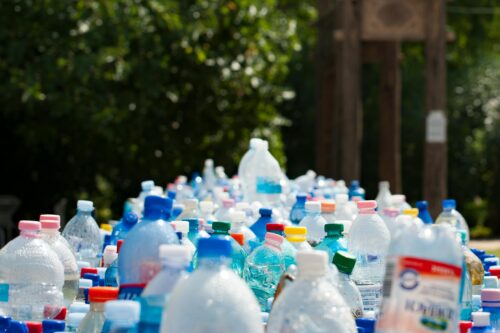
Plastic’s usefulness has a short lifespan. Schemes for recycling and burning plastic waste have limited success, and so plastic often ends up discarded, contaminating environments and the ocean. Pyrolysis is a promising approach to extend plastic lifespans; high temperatures break long plastic chains into useful products, such as jet fuel. However, conventional approaches suffer from limited yields since they produce a wide distribution of product sizes, including undesired short-chain products like gases and waxes.
A team of chemical and electrical engineers from Yale and beyond developed a simple yet powerful solution: a reaction column with gradually smaller pores and a built-in temperature gradient. Their design achieves high conversion into the desired liquid-fuel hydrocarbons without the need for catalysts, and it can be easily manufactured and scaled up.
“It is similar to the branching pores of a tree,” said Shu Hu, assistant professor of Chemical and Environmental Engineering at Yale. Much like nature’s approach, the design underwent many generations and iterations as the team tried eight hundred different samples.
Each sample consists of 3D-printed carbon nanomaterial pores. Within the pores, larger hydrocarbon chains move slower, so they spend more time in the reactor and are broken down into the desired smaller pieces, which rapidly exit the reactor before they become too small.
These modular reactors could be put together in plastic-recycling and fuel-production factories, but they are also small and elegant enough for other interesting schemes. For instance, modular reactors on trash-collecting boats could fuel and be fueled by the plastic collection process.