
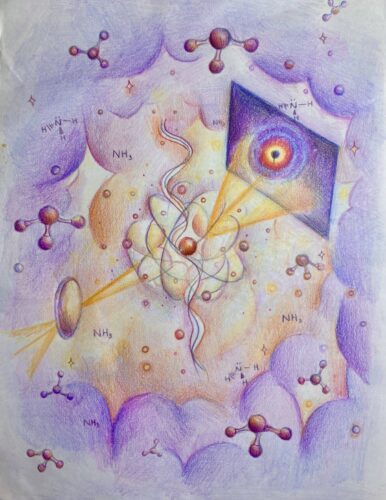
We’re all familiar with the adage of trying to find a needle in a haystack. But what if, instead, we made the needle a thousand times smaller than an atomic nucleus and added even more hay to the mix? Suddenly, the prospect of completing the task goes from unlikely to impossible. Scientists face this challenge when they try to record how electrons in the outermost shell of atoms rearrange themselves during chemical reactions. In a recent study, a team of researchers at the Stanford Linear Accelerator Center (SLAC) National Accelerator Laboratory led by James Glownia and Ian Gabalski used hard X-ray scattering—a method previously used to study only core electrons—to capture the “electron rearrangements” in a specific type of ammonia molecule.
When we use the term “electron rearrangement,” we’re referring to the exchange of electrons from one atom to another through the atoms’ outermost electron shells, known as valence shells. These interactions are important to our understanding of chemistry because, to put it simply, atoms are very picky. Atoms of almost all elements follow a pattern known as the “octet rule,” meaning that they want to have exactly eight electrons in their valence shell. However, not all atoms are made equally, and most atoms in their neutral state will have to either donate or receive an electron to achieve a full valence shell. To study chemical processes, scientists want to directly probe these rapid rearrangements of electrons. “If you can take a picture of those, then you can figure out what’s driving the chemical reaction directly,” Gabalski said.
We can get an up-close view of microscopic objects through hard X-ray scattering. Since electron orbitals are so small, about 10-10 meters across, we cannot study them with visible light. Instead, we have to use hard X-ray scattering because hard X-rays have shorter wavelengths more appropriate for fine detection. “[The process uses] short pulses of light—high-energy X-rays—to try and freeze the motion of atoms and molecules,” Gabalski said. The photons collide with the electrons, and thus their trajectory and intensity change. This generates a diffraction pattern, from which scientists can calculate the arrangements of electrons within a system. The snapshot has been taken.
In the recent study, the researchers used the light of ultraviolet lasers to excite the electrons in ammonia molecules. “When you photoexcite, you take an electron that’s really bound tightly to the molecule and you move it into a higher orbital, where it’s less localized—a phenomenon which can be observed via hard X-ray scattering,” Gabalski said. They know they’re observing changes in the electronic structure of the molecules because the hard X-ray snapshot changes as they predict. The particular photoexcitation of ammonia the researchers considered drives a chemical reaction in which a hydrogen atom leaves the molecule.
The study opens the door to tracking the “movement” of electrons within more complex chemical systems. It is worth noting that this study only examined the behavior of deuterated ammonia, which has an unusually low core-to-valence electron ratio. Scaling up to larger atoms might require a larger sample of data by multiple photon-electron interactions, since signals from core electrons tend to obscure those from valence electrons. “SLAC is actually working on a machine right now that’s going to try and solve this problem, providing high energy photons at high frequencies, thus increasing the spatial resolution and decreasing the time required for measurements,” Gabalski said. As a singular particle accelerator, SLAC is used by many researchers, so experimenters have stark time constraints when collecting data.
Even though the research was conducted at Stanford, these findings have a special connection to the Department of Chemistry here at Yale. Glownia’s father, J.H. Glownia, completed his PhD in chemistry at Yale in 1981, and his thesis directly laid the framework for the research breakthrough. We often instinctually view scientific findings as the work of one person or one team, instead of acknowledging the thousands of papers and decades of research it takes to achieve a “scientific breakthrough.” The Glownias’ research demonstrates the beauty of scientific development. “It’s common to find a paper from fifty or sixty years ago that turns out to be extremely relevant to whatever you’re working on. The reason that you want to fund and perform basic research like this is just because you never know when it’s going to become relevant,” Gablaski said. No matter the applications, it’s a crowning achievement that scientists have grasped that elusive needle at last.