
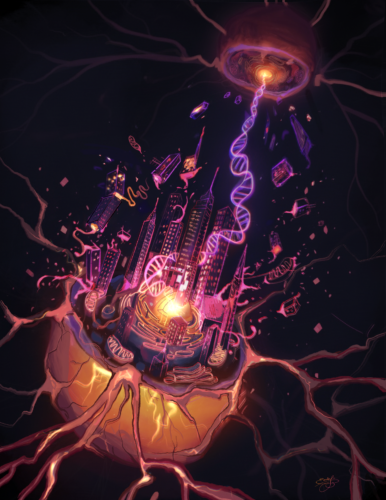
The human body contains an astonishing variety of cell types. Digestive cells secrete enzymes to break down food, brain cells fire electrical signals to form thoughts and drive actions, and muscle cells contract and extend to power every movement from lifting to speaking. Yet, all of these arise from a single fertilized egg.
Cell differentiation is a bit like students choosing careers. Early on, the fertilized egg divides into many identical cells—like children, they share the same basic potential. As development proceeds, signals from inside and outside the cell act like personal interests, mentors, and opportunities, nudging them toward one “fate.” Once committed, these cells undergo “training,” activating specific gene programs to specialize in this role. Differentiation mostly happens before birth, and terminally differentiated cells are often thought to be locked into place—but there are exceptions.
Some organs have stem cells that can self-replicate and differentiate. When differentiated cells age or get injured, or when more cells are required, stem cells supply fresh cells, maintaining flexibility.
Other organs, however, lack dedicated stem cells. This may be desirable, since stem cells mutate to become cancerous more easily than differentiated cells. But it raises a question: how do such organs repair themselves in case of injury? One answer is paligenosis, where mature cells temporarily revert to a stem-like state, divide, and, if all goes well, redifferentiate into functional cells.
Paligenosis was first described by Jason Mills, a professor at Baylor College of Medicine who studies how stomach cells respond to injury. His former postdoctoral fellow, Jeffrey Brown, now an assistant professor at Washington University in St. Louis, continues to study this process. Recently, the two labs collaborated on a Cell Reports article describing a newly identified step in paligenosis, which they termed cathartocytosis.
“I had been studying some processes alongside paligenosis, and what I was noticing is the cells were dumping a lot of stuff,” Brown said. “If it’s just autophagy, the antigens should go in the lysosome and get digested—they shouldn’t be shot out of the cell.” Autophagy, a recognized part of paligenosis, involves degradation of cellular compartments in cells’ enzyme-powered lysosomes, a kind of cellular garbage disposal system. In stomach cells, autophagy is characterized by the breakdown of zymogen granules, secretory vesicles that normally store and release digestive enzymes but which are no longer essential under injury conditions.
To probe this phenomenon, Brown and colleagues injected tamoxifen into the abdomens of mice to induce stomach injury. Using a carefully characterized antibody, they tracked changes in vesicle localization. In healthy cells, these vesicles were concentrated near the nucleus. But after twenty-four hours of injury, they began to appear outside the cells. By forty-eight hours in, all of the stained material had been expelled from the cells.
A key to this discovery was the synchronous injury of gastric cells. “Cathartocytosis happens between twenty-four and thirty-six hours. It’s a transient thing,” Mills said. “Most other [experimental] injuries are asynchronous, so if you see an invagination into a cell, it doesn’t mean that it’s a new process. But we saw every single cell doing this at the same time.”
To show the intricate structures that control how materials are secreted via cathartocytosis, Mills and Brown utilized an imaging technique called focused-ion beam scanning electron microscopy (FIB-SEM). By delicately dissecting microscopic structures with their instrument’s ion beam, they found that cathartocytosis occurred in the curved crevices on the cell’s top outer layer. Interestingly, a double-membrane cup-like structure called a phagophore is also involved in the degradation of materials in this process.
As part of the process, the authors observed direct fusion of the enzyme-containing granules with the crevices within the top layer of the cell membrane. Interestingly, this fusion of extracellular material is associated with the known function of pushing the vesicle’s content outward. This finding emphasized the novelty of cathartocytosis: the process is not simply a secretion process, as parts of the cell are released along with the excreted material.
Additionally, the lack of lysosome function in cathartocytosis further emphasizes its distinction from autophagy. Autophagy requires functioning lysosomes. Because of this, it is expected that lysosome markers should be colocalised with autophagic structures during paligenosis if this process is a type of autophagy. Brown and Mills did not observe this expected localisation in normal wild-type mice in their study of paligenosis.
To confirm lysosomes are not involved in cathartocytosis, Brown and Mills stopped the function of Epg5—a gene that controls the fusion of autophagosomes with lysosomes—in mice to study whether lysosomes would be involved in vesicle fusion with the membrane. Autophagosomes are vesicles that sequester damaged components of the cell during autophagy, and they fuse with lysosomes to degrade their contents. The researchers found that mice that lacked this gene showed fusion of the lysosome or late endosome, the precursor to the lysosome, with the outer membrane. On the other hand, mice with this gene do not show this fusion. From this finding, Brown and Mills concluded that secretory autophagy is not the main way that materials in the cells of normal mice are removed, and the crevice-like structure of the outer membrane is unique.
Thus, the researchers concluded that cathartocytosis is distinct from autophagy. “Now we have to modify our [model of the] early stage of paligenosis so that there are two parts,” Mills said. “One part is the degradation part, which is the traditional way that cells recycle stuff, and the other part is this new cathartocytosis—cell vomiting, or jettisoning process.”
The excitement of these results comes from the fact that a new explanation has evolved for a process that has been overlooked for decades. By testing how mature cells scale down their machinery to make sure they can proliferate and repair the tissue after an injury, the study supports how important lysosome and autophagic processes are. The discovery of cathartocytosis as a concurrent process to autophagic machinery emphasizes how intricate cellular processes can be.
Although the study was done on gastric cells, Brown and Mills both emphasised cathartocytosis as a potentially conserved mechanism across all cells. “Any tissue where there are no stem cells to repair or any injury system that needs to replace the lost cell mass can undergo cathartocytosis,” Brown said.
Currently, Brown is continuing to build on this project by identifying key gene markers that define cathartocytosis. This includes clearly laying out what the building blocks of this biochemical pathway and the genes that control this pathway are. By understanding the exact marker genes, not only will we be able to understand how cathartocytosis works, but also where it can go wrong in disease and what the potential treatment targets could be.