
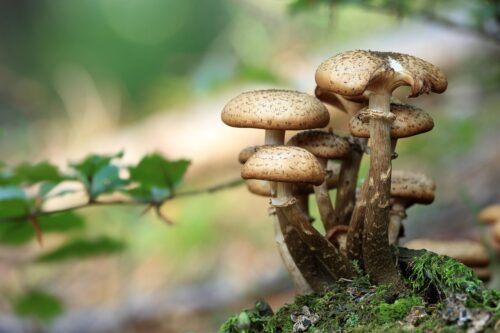
Mushrooms really are that good for you. These spongy fungi are full of vitamins and antioxidants which protect you from age-related cellular damage and power your daily life. Our bodies love mushrooms, and as it turns out, our gut microbiomes do too. The bacteria in your gut convert the nutrients in mushrooms into alternative energy sources, which would have otherwise been discarded as waste. In a recent publication, Yale associate professor of molecular, cellular, and developmental biology Stavroula Hatzios and her team optimized their own collaborative network to discover the microbial collaborations in our gut.
Ergothioneine (EGT) is a prominent antioxidant found in mushrooms. Antioxidants act as molecular guardians, forming a physical bubble around their target to protect small molecules from the harsh conditions found within the gut. But EGT is more than just a protector. The fungal-born antioxidant is converted into reduced thiourocanic acid (TUA), an electron acceptor, through a network of microbial interactions. Reduced TUA chemically stabilizes reactive molecules in our gut to prevent them from causing damage. Typically, oxygen acts as the primary stabilizer for damage-causing molecules in our microbiome, so alternative electron acceptors like reduced TUA are particularly helpful in oxygen-poor conditions.
Though antioxidants and electron acceptors both protect our cells from damage, the reduced TUA can also boost metabolism. After an electron acceptor reacts with an unstable species, kinetic energy is harnessed and transferred into chemical energy. In other words, the microbial interactions that occur after we eat EGT-containing foods like mushrooms allow us to take up more energy than would have otherwise been possible.
The molecular machinery behind EGT’s conversion into reduced TUA is a transporter found in many bacteria in our gut microbiome. This system enables microbes to capture dietary antioxidants and use them to withstand conditions of oxidative stress. In practical terms, the next time you order chicken marsala, those nutrients will enter your oxygen-poor gut and activate these microbial machines.
The metabolic effect may vary widely because the gut microbiome can be drastically different from person to person. “Some people may have more bacteria that produce this machine, but I expect most people have at least a few of these bacteria,” Hatzios said.
Interestingly, this variance was used to characterize the effect of EGT on mice’s metabolism. Hatzios and her research team tested three groups of genetically identical mice from different “pet shops,” and each group had different responses. Despite their DNA being exactly the same, the gut microbiome of a mouse from one lab had an entirely different composition than that of a mouse from another lab due to changes in their diet, activity, and environment. Small changes led to big differences in the way that these mice processed food. While one group could metabolize EGT into reduced TUA for added metabolic benefits, other mice lacked the machinery to do so. Hatzios’ findings suggest that we as humans may also be able to improve our metabolic efficiency not just by eating the antioxidants in mushrooms, but by altering our gut microbiome to digest them in more effective ways.
This is where the project may have ended if Hatzios had not created her own collaborative network at Yale. “We needed to perform broad computational analyses, and we don’t have the skills to do that,” Hatzios said. B happenstance, Hatzios’ colleague brought her and Xiaofang Jiang, a principal nvestigator at the National Library of Medicine, together. “They had the precise skillset to do it, and it didn’t take them long to generate this beautiful data […] it was like connecting dots,” Hatzios said. Their hypothesis—EGT boosts metabolism through commensalistic relationships between gut bacteria—was granted statistical significance by the deep analysis provided by Jiang.
Hatzios’ conclusions align with previous knowledge on the benefits of EGT as an antioxidant and clarify its function as a physiological electron acceptor. Low levels of EGT have been associated with cognitive decline and other negative health effects, so understanding EGT’s physiological functions and interactions can help optimize its benefits and treat deficits. Hatzios hopes to better understand the contribution of its molecular machinery to improve both human and microbial functions.
From microbial interactions in our gut to macro-scale interactions in Hatzios’ lab, our understanding of the power in mushrooms and the gut is a network of efficiency and collaboration. “Highly interdisciplinary work is required to be at the leading edge and drive forward new frontiers of science,” Hatzios said. “It’s more fun and more efficient if you can enlist great collaborators to work with you.”