
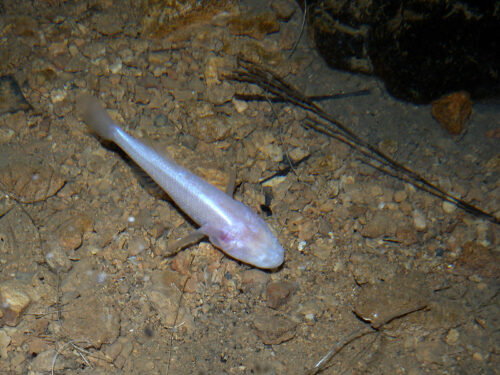
Deep in lightless caves, fish have repeatedly evolved into blind, eyeless forms. Rather than descending from a single ancestor, different lineages of cavefish independently lost their eyesight after adapting to life in complete darkness—a striking case of convergent evolution. Thomas Near, professor of Yale’s Department of Ecology and Evolutionary Biology, explains that his study provides strong evidence of this repeated transformation across multiple lineages.
Convergent evolution occurs when unrelated species develop similar traits in response to similar environments. Near used flippers as an example: whales and dolphins are most closely related to hippos, while seals are closer to cats and bears. Despite their different histories, all evolved flipper-like limbs for swimming. Similarly, cavefish across the globe repeatedly evolved blindness by developing pseudogenes, or “broken” genes, associated with sight.
His research also yielded an unexpected tool for geology. Traditional methods of cave dating, such as analyzing quartz isotopes, only work for caves younger than five million years. By comparing when pseudogenes emerged in different cavefish lineages relative to evolutionary splits, Near and his colleagues created a new way to estimate cave ages far beyond that limit. “By looking at the timing of when the cavefish pseudogenes originated relative to the evolutionary splits of the lineages, we are able to figure out how old the cave is,” Near explained.
For Near, the study reflects a renaissance in biodiversity science. Genomics and new methods of species discovery are reshaping how we understand evolution—and may even offer insights into human diseases that affect vision.