
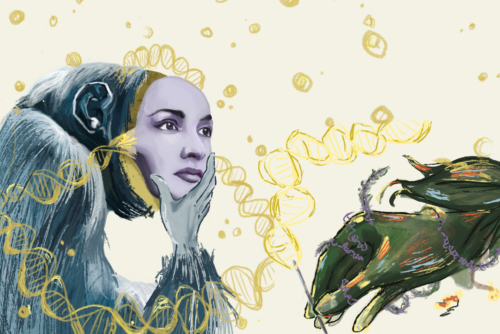
Humanity: the elusive concept that distinguishes Homo sapiens from the rest of the animal kingdom. The word has elicited an abundance of definitions, whether drawing from our adept sense for language, our bipedal locomotion, or our ability to fit the entirety of our species’ knowledge behind a pocket-sized glass screen. Few definitions are satisfying—in the grand scheme of evolution, what differentiates us from our primate counterparts? To answer this question, researchers from the University of California, San Diego (UCSD), pinpointed a DNA sequence named HAR123 in their recent study published in Science Advances. They believe this sequence previously known just for its link with neurological defects is in fact a crucial part of what makes humans cognitively unique.
Composed of 442 nucleotides, HAR123 is classified as a Human Accelerated Region (HAR). These DNA sequences are found in most mammals, but they have evolved especially rapidly in the human lineage since our divergence from the last common ancestor with modern-day chimpanzees. “Basically, there’s a lot of sequence differences between the human version of this series and the chimp,” said Miles Wilkinson, a contributing author on the study. They discovered that the human HAR123 has nine nucleotides different from the chimpanzee one. This is quite notable, given that these species only diverged between four million and seven million years ago. “You can look at other primates that might differ in twenty or thirty million years and only see one or two changes in nucleotides,” Wilkinson said. The rate of nucleotide changes prompted the team to conclude that HAR123 was a human accelerated region.
It’s important to note that HAR123 is not a gene. Of the ninety-seven percent of HARs that exist in non-coding regions of our DNA, this is no exception. “I think the reason why I was particularly excited is that this is not a gene; this is just a little teeny sequence in the middle of a gene,” Wilkinson said. It is instead considered an enhancer, which regulates genes near it in the DNA code. They discovered that only the human version of HAR123 targets a specific gene responsible for neural cell generation, called HIC1 (hypermethylated in cancer 1). Although more research is needed for confirmation, the unique regulation of this gene may have contributed to Homo sapiens’ cognitive advancements. Today, we know one thing for certain: “[The] human version of HAR123 has the highest efficiency to promote neural generation,” said Kun Tan, the paper’s first author. In comparison to the human sequence, the efficiencies of chimpanzees’ and mice’s enhancers were found to be suboptimal. These results imply that humanity’s cognitive evolution may be attributed, at least in part, to our advanced version of HAR123.
So what role exactly does HAR123 play in human brains? HAR123 amplifies the activity of HIC1, a gene that acts as a tumor suppressant by promoting the production of neural progenitor cells (NPCs). These NPCs are stem-like cells that later differentiate into neurons and glial cells, forming the foundation of the brain’s neural wiring. By increasing the pool of NPCs, HAR123 ensures that the developing human brain has the raw material necessary to expand. Regions such as the frontal cortex (responsible for abilities such as decision-making and abstract thought) and the hippocampus (key for memory and learning), are both dramatically larger and more complex in humans than in chimpanzees, and could be products of HAR123.
Beyond sheer neuron production, HAR123 also influences how neurons and glial cells function together and support the brain’s growth and complexity. While neurons carry the electrical signals, glial cells help regulate and support neural activity, thus maintaining the brain’s delicate balancing act of homeostasis. Preliminary data suggest that further research into these interconnected cells could reveal medical implications of HAR123. “There’s a strong association between the shifts in [the] ratio between neurons and glial cells and neurodevelopmental disorders,” Wilkinson said. While the enhanced production of neural cells may have given humans advanced cognition, it may have also made the brain more fragile. Our vulnerability to more complex conditions like autism, schizophrenia, and bipolar disorder may be linked to the very features that HAR123 helped shape. By altering the neuron-glia ratios in the brain, this enhancer has demonstrated the most classic theme in evolution: every gain comes at a cost. Our species’ most amazing abilities may, in part, be inseparable from our weaknesses.
The work of Tan, Wilkinson, and their colleagues opens doors for further research on HAR123. “We hope in the case[s] of [HARs and] even HAR123, that some of what we learn can ultimately be helpful from a clinical or medical point of view,” Wilkinson said. The researchers hope to explore whether variants of HAR123 influence individual differences in cognition as well as how HAR123 interacts with other HARs scattered throughout the genome. Understanding the role of HAR123 in individuals’ susceptibility to neurodevelopmental disorders could lead to biomarkers in prenatal or early childhood screenings, creating opportunities for earlier interventions. And at the therapeutic level, researchers could envision ways that the enhancer-gene interactions could be modulated for treatment of these cognitive disorders as well.
The researchers offered advice to young scientists working at the intersection of evolutionary genomics and neuroscience. “Continue asking the right questions,” they urged. Their curiosity and persistence evident, they explained how the importance of the field they were in was not only in the practical outcomes, but also in the pursuit of understanding. Evolutionary research must start from a place of pure curiosity, and as their work shows, it can yield profound insights.
HAR123 reminds us that evolution often works through small, subtle changes that ripple outward into far greater consequences. HAR123’s ability to expand our brain is a triumph but also a vulnerability—we must keep in mind that evolutionary advances come with a cost. Further research into this enhancer could help us understand not only where our cognitive abilities originate from but also how they fail us at times. Nevertheless, the same shifts in neural cell balance that HAR123 promotes may be the foundation of human creativity and abstract thought. From this little enhancer may have emerged the ability to tell stories, create art, and even ask the very question with which we began: What makes us human?