
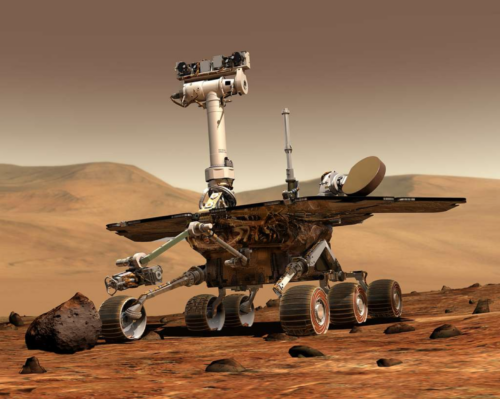
Electronic guitar rips through desolate space, the only sound beyond wind whistling through red sand. As the opening chords of the B-52s’ pop-rock hit “Roam” play, an old machine creaks and whirs to life. This is a Martian robot’s morning routine.
Good Night Oppy, a documentary released in 2022, chronicles the story of NASA scientists on a mission to find evidence of water on Mars. In the early 2000s, the scientists built two identical twin robots, Opportunity (nicknamed “Oppy”) and Spirit, and sent them on what was planned as a ninety-day operation. Not only did the rovers find water-related minerals, but their unexpected endurance brought public affection and even a sense of humanity to these machines.
The two robots’ journeys to Mars were tumultuous from the beginning. Steve Squyres, the principal scientist for the project, and his team spent ten years writing proposals before finally receiving approval from NASA’s Mars Program. Once given the green light, they had just two years to engineer and launch the rovers. With two recent Mars landing failures behind them, Spirit and Opportunity represented NASA’s last chance for success. The science team saw themselves as nervous parents to their identical twin explorers.
Spirit successfully landed on the surface of Mars on January 3, 2004. Oppy followed in her sister’s footsteps three weeks later. After a rocky start, Oppy detected hematite, a mineral typically formed in the presence of water. This revealed evidence of highly acidic water, too harsh to support life. Later, exploration of the Endeavor crater revealed clay minerals, proof that neutral-pH water once existed as well. Together, the findings suggested that Mars could have once sustained microbial life.
Oppy’s discovery is not the only thing that defined her legacy. Both Oppy and Spirit sparked renewed public interest in space exploration. “It’s just a box of wires, right?” asked Doug Ellison, the camera operations engineer for the project. “But you end up with this cute-ish looking robot that has a face.” Both rovers took on personalities, with Oppy as “Little Miss Perfect” and Spirit playing the role of the troublesome sister.
“Exploration and adventure can become a very large shared human experience,” said Squyres. Although designed to last only about ninety days on Mars, Oppy spent fifteen years exploring the planet. As the mission came to a close, the final wake-up song crackled over the speakers and Billie Holiday’s voice sang, “I’ll be looking at the moon / But I’ll be seeing you.”