
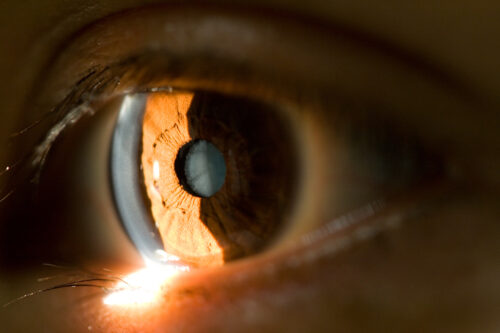
Vision is central to perception, linking the self and the world. But what happens when people are stripped of sight? As a teenager, Brent Chapman developed severe corneal blindness after an adverse drug reaction. In a desperate attempt to regain his vision, Chapman underwent nearly fifty medical procedures. Eventually, one worked: tooth-in-eye surgery.
As strange as it sounds, osteo-odonto keratoprosthesis (OOKP) involves creating an artificial cornea from the patient’s own tooth. “It is a rare operation that most people have not heard of, even if you are an eye surgeon,” said Greg Moloney in a CBC article. Moloney is Chapman’s ophthalmologist at Mount Saint Joseph Hospital.
To carry out OOKP, surgeons remove a canine tooth and shape it to hold an artificial optical lens. This tooth-lens prosthesis is then implanted into the patient’s cheek, where it integrates with blood vessels and connective tissue to reduce the risk of rejection. After about three months, the unit is transplanted into the patient’s eye to serve as a new cornea.
Chapman is not the only success story. After undergoing the same surgery, seventy-five-year-old Gail Lane was able to see her partner’s face for the first time in a decade.
OOKP has demonstrated strong long-term results. In one study, implants remained anatomically intact in ninety-four percent of cases, with many patients retaining functional vision for years or even decades. While outcomes vary, the evidence suggests that OOKP can offer lasting sight where other treatments fail. OOKP reminds us that sometimes the solution lies within ourselves, in our very own teeth.