
It’s the Late Cretaceous Period, and you’ve been teleported to southern Patagonia—or what will eventually become southern Argentina in seventy million years, give or take. It’s the apotheosis of the dinosaurs, but, according to a recent discovery, you will have had to worry about more than just fierce land-dwelling reptilians.
In early 2020, at the Chorillo Formation of Santa Cruz, Argentina, a team of researchers chanced upon parts of a mysterious skeleton. Stretching three-and-a-half meters long, weighing the equivalent of a fully-grown male African lion, and with serrated teeth double the size of its narrow-snouted peers of the time, this crocodilian creature constituted the discovery of a new genus, which the researchers named Kostensuchus atrox. It was found remarkably well-preserved, prompting researchers to consider how the fossils remained intact. “When [Kostensuchus] died and fell at the bottom of a shallow lake, the fine grains of the mud engraved the body quickly. The rotten organic matter of the corpse interacted with the mud, which acquired a compact and hard condition with the course of thousands and millions of years,” said Fernando Novas, one of the study’s lead researchers currently affiliated with the Fundación de Historia Natural Félix de Azara.
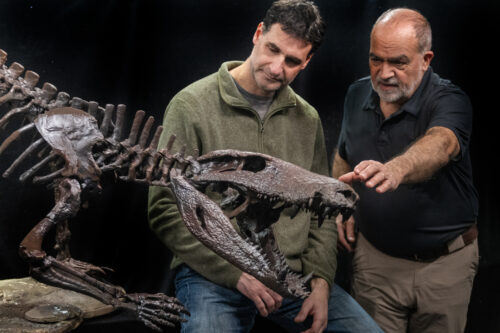
After five painstaking years of removing K. atrox from its rocky prison, the team was excited to reconstruct and mount the complete skeleton of this new crocodile. Unfortunately, the specimen was found to be missing its legs and tail, which likely weren’t buried quickly enough to avoid erosion. In order to fill in the gaps, the researchers had to rely on preexisting knowledge and 3D printing to finish the job. “Fore- and hindlimb bones were reconstructed [digitally] on the basis of close relatives of Kostensuchus,” Novas said. The tail, on the other hand, was modelled primarily after the caiman, a living alligatorid native to South America. After some tweaking to ensure a smooth articulation, these reconstructed bones were painted to imitate the original and seamlessly integrated into the original skeleton.
The team didn’t stop there. After completely scanning the final skeletal structure, the scientists worked with digital artists who specialize in recreating long-extinct creatures. The artists used modern animals as references for the color and texture of long-decomposed softer tissues, including skin, scales, and cartilage. As for Kostensuchus’ mass and muscles, the team gained insights from various studies. When properly depicting the muscle mass of extinct creatures, there is a general rule of thumb that is followed. “If you measure the humerus and the femur, their circumference has a very nice correlation with body mass,” said Diego Pol, principal researcher at the Museo Argentino de Ciencias Naturales. However, for crocodilians similar to Kostensuchus, a different formula needed to be used. “There are many studies that have measured skull length to correlate better.”
The discovery of Kostensuchus will shine light on the ecosystem of the region, demonstrating that dinosaurs may not have been the only apex predators of the time. “There’s still a debate if biodiversity was in crisis before the extinction event, or if the extinction was so sudden that life was doing well one day, then the asteroid hit the planet and created a massive catastrophe,” Pol said. The survival of such diverse crocodilian lines into the Late Cretaceous Period may help scientists understand the ecological interactions that occurred before, during, and even after the extinction event.