
When you read the word “pollution,” what’s the first thing that comes to mind? Is it the heart-wrenching image of a sea turtle ensnared in the deadly plastic rings of a soda can holder? You may think bigger: industrial smokestacks or the environmental damage of an oil spill. Whatever it is, it’s no secret that pollution comes in many forms. And while most of us strive to take on our fair share of recycling, there’s one invisible form of pollution that has us completely hooked. You’re taking part in it right now, just by reading this article.
For radiofrequency electromagnetic fields (RF-EMF), stealth is the name of the game. As you read, these invisible radiomagnetic waves are delivering wireless Wi-Fi signals to your device. Stretching across every urban environment, these invisible webs follow us and raise an important issue in cities—not for us, but for the tiny neighbors we share our streets with: insects.
At the University of Hohenheim in Germany, a group of researchers led by graduate student Manuel Treder studied the effects of RF-EMFs on bumble bees and honey bees in particular, which are often overlooked members of man-made ecosystems. They asked: What if bees are negatively impacted by the presence of RF-EMFs in urban environments? Could this force them to avoid foraging in certain areas, and, in doing so, stress their population?
The researchers conducted experiments at the State Institute of Bee Research, where they constructed a controlled garden, featuring lavender and sage to attract pollinators. Over the course of two years, they “irradiated” the feeding grounds by exposing the plants to RF-EMFs on an alternating schedule. By recording where the bees visited, the researchers assessed whether the foraging behavior of any pollinator groups changed when the plants were irradiated.
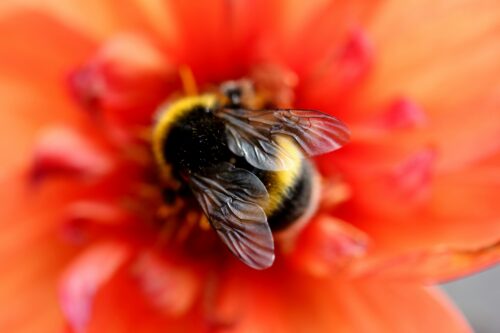
For bumble bees, the difference was glaring: these pollinators visited irradiated flowers twenty-eight percent less, indicating that RF-EMFs disrupt normal foraging. Honey bees also visited irradiated flowers less, although the difference was less pronounced.
Why does this matter? If urban bumble bees avoid irradiated plants, which constitute the majority of urban plants, then their food options are severely limited, forcing them to travel greater distances to reach uncontaminated plants. Foraging in this manner causes these critical pollinators to exert staggering amounts of energy, placing “stress” on their population.
But this “stress” extends far beyond the bumble bees—plants that rely on the bees for pollination will also feel the effects of radiation. “We should be concerned because bumble bees are key nodes in pollinator networks across both natural and anthropized (urban or agricultural) environments,” said Walter M. Farina, a professor and bee physiology specialist at the University of Buenos Aires. Farina explains that globally, ninety percent of flowering plant species rely on pollination. “Within urban environments, the regular visitation of pollinators to healthy floral resources supports their own health and reproductive success, while also enhancing biological diversity in these areas,” Farina described. If these plants are pollinated at decreasing rates, their populations may also be at risk.
In future studies, the researchers seek to understand how RF-EMFs interfere with the physiological mechanisms underlying bumblebee foraging. The researchers also aim to answer why bumble bees reacted to irradiated plants more than honey bees.
Although there’s much to be discovered about this process, the impact is known. At its core, inhabiting a shared planet comes with the same responsibility as sharing a suite at Yale—it’s important to consider how our actions impact our roommates. As Treder and his colleagues demonstrated, it begins with a genuine attempt to understand the organisms that we share our urban environments with, in order to create conservation efforts that promote coexistence.