
It’s 1993, and dinosaurs are having a moment—and it’s not the release of Jurassic Park. Deep in Mongolia’s Gobi Desert, an expedition by paleontologists from the American Museum of Natural History is reshaping our understanding of the prehistoric past.
The expedition was led by Mark Norell (GSAS ’88), who at the time was a freshly minted biology PhD from Yale. For decades, Western scientists had been barred from leading expeditions into the Gobi under Soviet Union rule. When those restrictions were lifted, Norell’s team and collaborators from Mongolia were there to survey the land. They weren’t going in blind—beautiful fossil specimens had been discovered in the region during the 1920s, and many more likely still lay buried beneath the desert sands. Finding them, however, would be difficult, backbreaking work, without any guarantee of results.
Isolated in this alien landscape, the team searched tirelessly for beds of rock that might host fossils. Igneous rocks, formed from cooling magma or lava, wouldn’t work; neither would metamorphic rocks—the extreme heat and pressure that forge them would also have incinerated prehistoric remains. What they needed was an exposed bed of sedimentary rock—layers of rock fragments, shells, mud, and sand compacted over time.
The paleontologists explored the harsh environment for years, searching for the slightest hint of fossil: a pale bone fragment set against sandy ground. And one fateful day, shards of prehistory began to reveal themselves. A cranial fragment here. A vertebra there. Soon, the miscellaneous parts of an entire dinosaur were uncovered, and then another, and then another. It was a paleontologist’s dream. Pickaxes struck the earth, and bones were raised from the ground. The fossils were excavated and coated in protective plaster, and the dinosaur bones were carefully packaged and shipped halfway across the globe to the American Museum of Natural History, where Norell was a curator.
Even now, over thirty years later, the fossils Norell collected continue to yield new insights into dinosaur evolution. Norell passed away in September 2025, but the research group he led at the American Museum of Natural History continues to build upon his fossil collections. In a study recently published in Nature, teams from Yale and Stony Brook University independently came across a curious finding and joined efforts to dig deeper into the origins of avian flight.
Pisiform Physiology
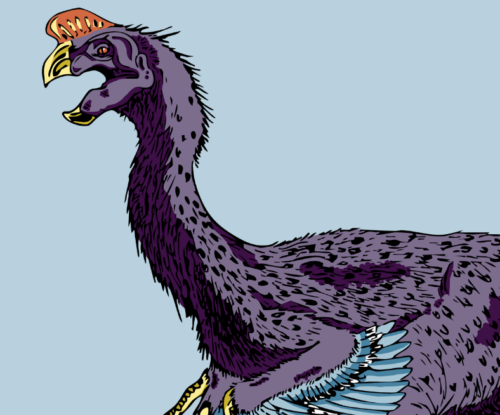
One side of the search began at Yale, where Alex Ruebenstahl (GSAS ’28), a PhD student researching phylogenetics and physiology, was staring at a peculiar bone from an early flightless dinosaur. The bone was a small knob in the wrist called a pisiform. Throughout his years of study, Ruebenstahl could not recall having ever seen the pisiform bone in that spot mentioned in theropod dinosaur literature before. The dinosaur Ruebenstahl was looking at was a troodontid, a member of the carnivorous, bipedal “theropod” group of dinosaurs. As Ruebenstahl continued to mull over the puzzling finding, he called his colleague James Napoli, who was a graduate student in Norell’s lab at the time, to relay what he had seen. As fate would have it, Napoli had also been puzzling over the same bone in wildly different dinosaurs: Citipati, a group of toothless, emu-sized dinosaurs from a separate branch of the theropod family, the oviraptorids. While troodontids and oviraptorids are distinct groups, both share similar, bird-like traits. And in this case, they shared something even more surprising: the puzzling pisiform bones.
“I had already been curious to find out what bones Citipati had in its wrist, and the pisiform was an unexpected discovery showing that it was, in some ways, more bird-like than we had once thought,” Napoli said.
Theropods are useful paleontological models because they represent a stepping stone between dinosaurs and birds, and thus, the evolution of flight. One key area of focus is the wrist, where millions of years of evolution have melded and reforged bone to be lighter, stronger, and better-suited for flying. The wrist is made up of small, jigsaw-like bones called carpals.
The two long bones found in the forearm, the radius and the ulna, meet at the wrist where their respective carpals, the radiale and the ulnare, are found. However, in living birds, embryological studies show that the ulnare disappears during development and is replaced by a mysterious bone often called the “pseudoulnare.” Recent studies have shown that the “pseudoulnare” is actually the pisiform, a carpal that migrates during development to fill the vacancy left by the vanished ulnare.
Exploding Dinosaurs
The paleontologists hypothesized that the pisiform replaced the ulnare only in birds, coinciding with the evolution of flight. But proving the pisiform connection required more than simply noting a similarity. To be rigorous, the scientists needed to reconstruct exactly how the pisiform fit into the wrist apparatus that made flight possible.
That was easier said than done. The fossil evidence was fragmentary—literally—and the soft tissues that had once held small bones like the pisiform in place had long since decayed. All said, it’s extremely difficult to piece a dinosaur back together again. “These bones kind of completely explode when they’re preserved—explode in the sense that they go all over the place,” Ruebenstahl said. “It’s really hard to figure out where some of these smaller wrist bones went.”
In the lab, paleontologists use computed tomography (CT) scanning to produce a comprehensive 3D model of the bones. CT machines use X-rays to create an image of the bones, based on the differences in density between bone and surrounding rock. This allows them to study the structure without destroying the fragile bones. Once everything is visualized on the computer, the job of piecing parts together becomes considerably easier, and scientists can make concrete observations about the bones’ appearances.
“In more advanced birds, [the pisiform] is this rectangular bone with all sorts of bits and processes and stuff jutting out,” Ruebenstahl said. “And in our guys, it’s this very simple, rounded, little spherical bone, which suggests that its uses aren’t as complex.” To place this in context, the researchers also assembled a phylogenetic “supertree,” a large map combining many evolutionary trees to track how species branched and diverged. Their analysis challenged the earlier view that the pisiform was absent in theropods. Instead, Napoli noted, it may have never been lost at all, but persisted as cartilage.
The findings present a much more nuanced view of birds’ evolutionary past. “The evolution of birds is kind of this mosaic, piecemeal thing,” Ruebenstahl said. “Not every feature related to flight or [that] makes something a bird showed up at the same time.” This staggered evolutionary timeline has made piecing together the puzzle all the more difficult for evolutionary biologists. Traits don’t emerge in a neat, linear order. Under the pressure cooker of time and natural selection, a trait that helps a species thrive in one biome may be harmful in another. The findings cast doubt on Dollo’s law, which holds that once a structure is lost, it cannot re-evolve. They suggest that flight arose in dinosaurs multiple times—at least twice, and possibly as many as five or six times.
The Sky is the Limit
While the pieces of the puzzle are starting to come together, Ruebenstahl highlighted how much is still unknown. Citipati and the unnamed troodontid are both from the late Cretaceous period, around seventy million years ago. However, most of the key evolutionary changes likely occurred approximately one hundred and sixty million years ago, a gap that Napoli and Ruebenstahl are interested in exploring. The pisiform’s appearance in both flighted and non-flighted dinosaurs remains a curiosity. “We need more fossils from the early evolution of these mediating dinosaur groups to figure out if the wrist bone is evolving multiple times in dinosaurs,” Ruebenstahl said. However, until that data arrives, one question about bird flight remains: It’s not “chicken or egg,” but “bird or bone?” To channel Napoli’s enthusiasm: “Much more exciting science to be done!”
The author would like to thank Alex Ruebenstahl and James Napoli for their time. The author would like to recognize Mark Norell, who led many archaeological expeditions that led to this study’s findings. Norell passed away in July 2025.