
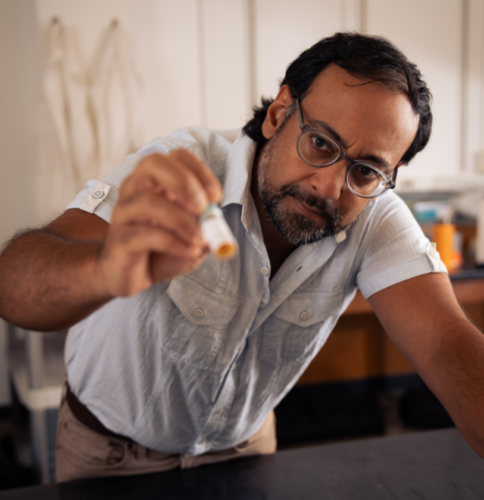
For Nabarun Dasgupta (YSPH ’03), the summer of 2002 marked a turning point. While studying OxyContin use with a Yale School of Public Health professor, he found himself connecting his earlier interest in chronic infections to what would become a lifelong mission: understanding and preventing drug overdose.
“It changed my life. It changed the trajectory of my professional career and helped me find the thing that I get meaning out of,” Dasgupta said. In the decades since, he has continued to build on these early experiences—and on the mentorship of Yale professors who showed him how to combine rigorous academic research with responsible advocacy.
As an undergraduate at Princeton University, Dasgupta cultivated an interest in infectious diseases that he continued pursuing at Yale, where he earned his Master of Public Health in the epidemiology of microbial diseases.
After completing a PhD in Epidemiology at the University of North Carolina at Chapel Hill (UNC) in 2013, Dasgupta joined the UNC Injury Prevention Research Center, where he studies opioid use and overdose prevention. His projects span database analytics, field studies, laboratory research, randomized trials, and community-based interventions. He also leads the UNC Street Drug Analysis Lab, which performs chemical analyses of drug supplies to identify harmful contaminants and inform harm reduction strategies.
Dasgupta’s impact extends well beyond academia. He has advised agencies including the Centers for Disease Control and Prevention (CDC), the World Health Organization (WHO), and the US Food and Drug Administration (FDA). He serves as an editor for the American Journal of Public Health, and he was named to the TIME 100 Next list of emerging global leaders in 2023. In 2025, he received a MacArthur Fellowship—a “no-strings-attached” grant of eight hundred thousand dollars supporting creative individuals addressing urgent societal problems.
With this award, Dasgupta plans to expand the horizons of his research by collaborating with partners in Latin America and Canada to study harm reduction efforts and the flow of drugs throughout the Western Hemisphere.
A hallmark of Dasgupta’s career has been his direct engagement with those affected by drug use and his commitment to amplifying patient voices through research and advocacy. Although Dasgupta acknowledges that some research groups maintain a strict divide between academics and advocacy, he stands firmly by his approach. “The science is better because you’re actually answering questions that can inform making people’s lives better,” Dasgupta said. “The work is also more fulfilling because you are working with the community and there’s direct feedback.”
Dasgupta has also translated research into tangible impact through Project Lazarus, a nonprofit supporting community-based overdose prevention, and Remedy Alliance for the People, which distributes naloxone, a drug that reverses opioid overdoses, to harm reduction programs.
As misinformation proliferates, Dasgupta has turned his analytical eye toward understanding public mistrust of science itself. He attributes much of the skepticism to how scientists communicate their findings—often without sufficient context or in overly technical language.
By researching public mistrust of science, Dasgupta hopes to shed light on the factors that contribute to this damaged trust, to better inform how he and other scientists communicate the results and impacts of their work. To model a more transparent approach, Dasgupta launched a blog for the Street Drug Analysis Lab, sharing data through graphs, photos, datasets, and stories. The blog has gained recognition as a model of clear, accessible science communication.
Through science and advocacy alike, Dasgupta seeks to bridge the gap between laboratory research and lived experience. “Our mission is to liberate knowledge and technology to help people answer the questions that are most directly relevant to them, […] to help create new information that is so relevant to them that it inherently inoculates them from being susceptible to misinformation,” he said.
In a time where misinformation is rampant and skepticism of science abounds, Dasgupta leads what he calls “science in service,” an innovative and inspiring approach in which research is not confined to laboratories, but shared, trusted, and shaped by the communities it seeks to serve.