
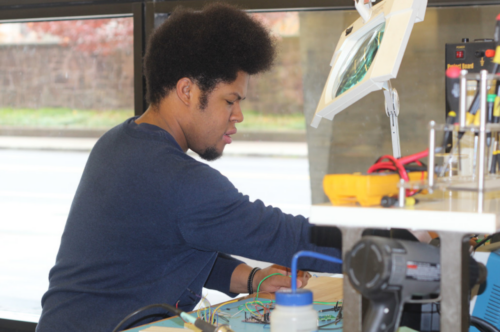
As a child, Sean Lewis (YC ’26) spent hours glued to the Science Channel, mesmerized by black holes and planets. His parents nurtured his passion with space-themed books and toys. By high school, Lewis had moved from watching science to practicing it, predicting how a ball might fall or how electricity and magnetism interact.
When Lewis arrived at Yale, he found the Yale Undergraduate Aerospace Association (YUAA) at the extracurricular bazaar and knew he had to join. Starting on the Cosmic Radio Detector subteam, he worked his way up to become project lead for the CubeSat—a miniature satellite that will soon orbit Earth.
The CubeSat Project partners with NASA’s CubeSat Launch Initiative, which gives students the opportunity to design and launch real satellites. CubeSats are small, lightweight spacecraft built from modular cubes, individually referred to as “U” units. Yale’s CubeSat will consist of two such units. Its mission is to detect cosmic rays above Earth’s atmosphere and map their density, especially within the South Atlantic Anomaly, a region with unusually high radiation penetration.
Lewis’s fascination for astrophysics led him to an internship at NASA’s Jet Propulsion Lab in Pasadena, California, the birthplace of iconic Mars rovers such as Spirit and Perseverance. At the lab, Lewis worked on the cosmology team for SPHEREx, a satellite mapping the entire celestial sphere. “It was really fun. It was a really exciting time to be at [the] Jet Propulsion Lab,” he said. “There was a little bit of an air of fear, which I presume is probably the same as now with the government budget cuts.”
Recent federal budget cuts have cast uncertainty over the future of US space exploration. The Trump administration’s proposed plan would reduce NASA’s overall budget by about twenty-four percent and cut funding for NASA’s science research programs by nearly half. In October 2025, the Jet Propulsion Lab laid off roughly 550 employees—around eleven percent of its workforce.
Even amid these federal setbacks, the YUAA’s CubeSat project has remained relatively insulated. “It hasn’t fully hit it yet,” Lewis said. “It has been hard knowing whether we’re going to be getting different Yale grants that give us the money to be able to build things. CubeSat is a little bit less affected, partly because we just need less money.”
As he looks toward graduate school, Lewis admits he is anxious. In response to funding cuts, many programs across the country are shrinking their incoming classes, making competition even more intense than before. “I’m scared,” he said. “Many programs only accept about fifteen people, so cutting even three spots is major.”
National fellowships have also been squeezed. The Graduate Research Fellowship Program (GRFP), funded by the National Science Foundation, delayed its application deadlines this year due to federal changes. The rules have also tightened. People in the second year of PhD programs school are no longer eligible, so those who waited to apply cannot anymore.
Lewis remains committed to pursuing a career in science. “I’m not even sure if NASA is going to be a thing by the time I’m ready to graduate from grad school. I’m just hoping that at the very least, astrophysics still stays a career that’s possible in the United States,” he said. “Many of the things that I love, the places that I’ve looked up to, are being gutted right now. I’m hoping that by the time I graduate, people are changing the political landscape and current climate of the United States so that I’ll be able to actually be an astrophysicist and do what I love.”
Lewis noted that while US funding wanes, international agencies are surging ahead. The European Space Agency (ESA), for example, is developing the Laser Interferometer Space Antenna (LISA), a mission designed to detect gravitational waves from space. China has also recently launched its own space station. “It’s sad seeing those space groups grow whereas ours is slowly being gutted and the funding taken away,” Lewis said. He pointed out that many modern medical technologies, including MRI machines, originated from space research. Lewis hopes to see renewed investment in space telescopes and exploratory probes. “I think they’re very important to answering the questions in space and getting people excited. Space is one of the few things that everybody gets excited by,” he said.
Lewis’s team is excited to send their CubeSat into space soon. His priority is ensuring his team is ready for what is to come before he graduates.