
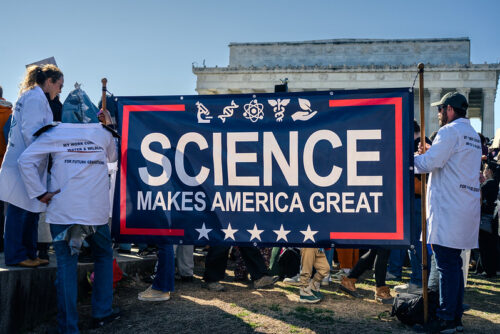
In 2008, presidential nominees Barack Obama and John McCain participated in an online debate on the top science issues facing the nation, each providing their own written responses to a set of questions prepared by the organizers of ScienceDebate.org. Originally launched as Science Debate 2008, the grassroots campaign for a public presidential debate on science emerged from a growing sense of uncertainty regarding the relationship between politics and science in the United States. If George W. Bush (YC ’68) could veto expanded federal funding for embryonic stem cell research because it clashed with his ideological beliefs, what role would future leaders take in shaping science policies?
When asked how they would navigate clashes between scientific information and personal beliefs in their decision-making, both Obama and McCain agreed on the need to move away from political interference. In fact, Obama’s responses would soon set the precedent for his presidential science policy, which included appointing expert scientific advisers, strengthening the role of the nation’s Chief Technology Officer, expanding the oversight of the President’s Council of Advisers on Science and Technology, and issuing a memorandum in 2009 that established the foundations of scientific integrity across federal agencies.
However, over fifteen years later, as current government leaders increasingly interfere with scientific policymaking, it seems that these guiding principles have been forgotten.
The growing trend of policymakers undervaluing scientific expertise in the United States can be traced in large part to the 2024 Supreme Court’s decision to overturn Chevron v. Natural Resources Defense Council, the 1984 case that established the long-standing Chevron Doctrine. For decades, this doctrine required courts to defer to a federal agency’s reasonable interpretation of a law when the statute’s language was ambiguous. The doctrine has historically empowered federal agencies like the Environmental Protection Agency and the Food and Drug Administration to craft regulations based on expert opinions and has been cited by federal courts over eighteen thousand times.
Justice Elena Kagan, who dissented during the ruling, emphasized: “The majority today gives itself exclusive power over every open issue—no matter how expertise-driven or policy-laden—involving the meaning of regulatory law.” As Kagan echoed, the ruling stripped power away from scientific advisers and instead opened the door to less expertise-driven policymaking.
But policymakers are not just undermining the role of scientific expertise—they are also actively building distrust against it. Health Secretary Robert F. Kennedy Jr., for example, removed all seventeen members of the CDC’s Advisory Committee on Immunization Practices (ACIP), a board that, according to American Medical Association president Bruce A. Scott, has guided lifesaving vaccination policy for generations.
Kennedy cited “conflicts of interest” and “bias in scientific evidence” as justification for the removals. Yet the decision has deepened public skepticism toward vaccine guidance. Kennedy has long promoted misinformation about vaccine safety, raising the question: what happens to public health when science goes dark?
The answer is already visible. The United States is experiencing its largest measles outbreak since 2000, with more than 1,600 reported cases. In Texas, the state with the highest count, ninety-nine people were hospitalized, and two unvaccinated children died, marking the first US measles deaths since 2015. For decades, widespread vaccination had nearly eliminated the disease in the US, but ideological interference in science policy has helped fuel an anti-vaccine resurgence that threatens to reverse that progress.
Texas has also become a flashpoint for another clash between ideology and evidence. House Bill 7, set to take effect on December 4, 2025, will prohibit the manufacture, distribution, and provision of abortion-inducing drugs in the state. The law, signed by Governor Greg Abbott despite opposition from the Texas Medical Association, marks yet another instance in which legal ideology overruled scientific consensus.
Whether undermining vaccine confidence or legislating reproductive care, today’s policymakers have entered the scientific sphere like never before. The large-scale dismissal of scientific evidence in the courts, state legislatures, and the White House replaces the principles of scientific integrity once championed by Obama and McCain with a new, dangerous norm, one where politics becomes the new peer review.