
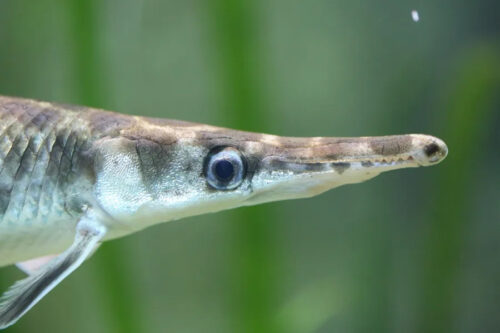
What can organisms stuck in time tell us about our own biology? Gars, a lineage of predatory, freshwater, ray-finned fish in the family Lepisosteidae, may have the answer. “Gars are a classic example of a term that Darwin coined, living fossils,” explains Chase Brownstein, one of the Yale researchers who observed the genomic architecture of these fish in a recently published paper. Alongside Liandong Yang at the Chinese Academy of Sciences, these researchers were interested in exploring questions regarding evolutionary patterns and the genetic parameters that act as evolution’s toolbox. Gars are a useful model system because they belong to an ancient lineage whose last common ancestor dates all the way back to 110 million years ago—long before the appearance of the first T. Rex! “The fossil record of gars also picks up around then. We have perfect skulls that have been found in the deserts of Morocco,” says Brownstein, “If you look at fossils 100 million years ago and then look at them today, you can only tell they’re different species by a handful of tiny little features in the bones, or how many scales they have on one scale row. If you think about it, there is nothing remotely resembling a person [Homo sapiens] from 100 million years ago.”
Evolution is still happening, but comparatively, there’s hardly any change to their skeletons or bodies. What exactly is going on? Back in 2024, Brownstein and Near published a paper highlighting that gars and sturgeons, another group of fishes, have the slowest rates of change in protein coding genes across all jawed vertebrates. The new study asked whether this evolutionary stasis extends to the structure of the genome itself. Using newly assembled chromosome-level genomes of two gar species, they found that genomic organization in these fishes is remarkably conserved: more than eighty-three percent of their genomes remain identical despite over 100 million years of divergence. The gars showed exceptionally low rates of chromosomal rearrangement, preserving stable gene order across their genomes. The study also points to unusually low activity of mobile DNA sequences such as transposable elements as a potential mechanism underlying the stability. Such slow accumulation of genetic changes provides an explanation for why there are only seven living species of gars today. It may also help explain the striking observation that divergent gar lineages are still capable of hybridizing in the wild, producing fertile offspring.
Many of the popular fish species used in biomedical research today, such as zebrafish, had actually undergone whole genome duplications during lineage divergence in Teleostei, a larger clade within ray-finned fishes. Gars lack this duplication, providing a crucial evolutionary bridge between humans and other fishes. By studying how their genomes resist rearrangement and suppress disruptive elements like transposable sequences, researchers are working to better understand the mechanisms that maintain genomic integrity. When these processes break down in humans, they can be linked to diseases such as cancer. Studying these ancient fishes may ultimately reveal fundamental principles that shape genetic change across all life.