
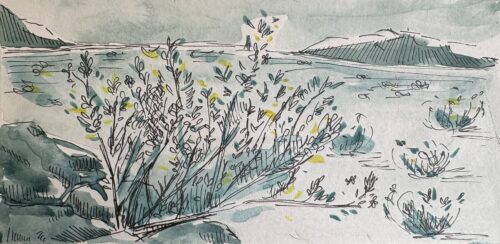
The sagebrush sea spans more than four hundred million
acres across the Western United States. Big sagebrush
(Artemisia tridentata) supports a dazzling diversity of
plants and animals—forbs, flowers, and other plant communities
thrive in the understory, and elk, pronghorn, and mule deer
browse on the foliage and flowers. The survival of some species,
like the bird known as the greater sage grouse, depends entirely
on big sagebrush.
Enduring brutal winters and blistering summers, big sagebrush
has earned a reputation for resilience. However, a new study
published in Global Change Biology conducted at the Yale School
of the Environment exposes the vulnerability of big sagebrush to
global warming.
The study was led by graduate student Sam Wilson (YSE ’24),
who investigated big sagebrush die-offs across six sites in Nevada,
Utah, Colorado, and Wyoming. Using field observations, remote
sensing, weather records, and modeling to simulate past, present,
and future weather, Wilson identified a pattern. In the year before
sagebrush mortality events, the majority of sites experienced an
abnormally high number of hot, dry days. The probability of
these extreme events was low during the twentieth century, but
has increased in the past few decades, and may intensify further
in future years.
If greenhouse gas emissions continue at their current rate,
intensifying global warming, mortality conditions are projected
to rise across the region. “There’s not really any safe spots in the
Western United States for big sagebrush,” Wilson said. “Certainly,
we were not expecting to see something like that.” If one of the
hardiest ecosystems on Earth is unable to escape the unfolding
consequences of the climate crisis, what does that mean for the
rest of the planet?