
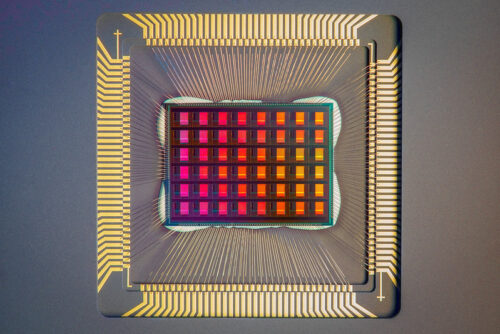
What if we could make computers that function like a human brain? Since the 1980s, scientists have been trying to engineer circuits that behave like clusters of neurons, which they call “neuromorphic chips.” “The idea behind neuromorphic computing is to try to build electronics that are inspired by what we know about human brains with the long-term goal to replicate their efficiency for certain tasks,” said Rajit Manohar, the John C. Malone Professor of Electrical & Computer Engineering.
As scientists develop larger and more complex neuromorphic chips, it becomes harder to keep everything synchronized. However, Yale researchers are up to the challenge. In a new study published in Nature Communications, engineers in Yale’s Computer Systems Lab designed “NeuroScale,” a neuromorphic architecture that can localize synchronization between cores—independent groups of neurons that can execute program tasks—to improve the efficiency and scalability of their systems.
This synchronization is achieved by allowing neighboring cores to “talk” to one another in a system called Network-on-Chip. Most computers need a constant clock pulse to keep everything running on time, a process called global synchronization. However, NeuroScale is able to stay on beat using only interactions between neighboring cores, a phenomenon called local synchronization.
As neuromorphic chips become more powerful, the group hopes to develop a hybrid model that harnesses the benefits of both global and local synchronization. “Both synchronization methods have drawbacks. We are trying to come up with a hybrid way to combine them together and implement them as a new synchronization mechanism in the architecture, so that we can gather all the benefits from both of the synchronization ways,” said Congyang Li, the first author of the study.