
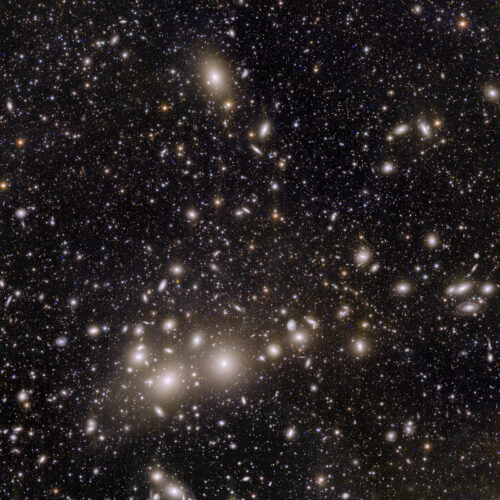
Containing over a thousand galaxies and billions of stars, the Perseus Cluster helps astronomers study some of the most powerful and exotic phenomena in the universe. It is hard to fathom the gargantuan scale of the Perseus Cluster: even though it lies over a quintillion miles from Earth, the cluster is so enormous that it appears many times larger than the full moon in the night sky. The core of the cluster is immersed in an emulsion of extremely hot gas, measuring between ten and one hundred million degrees Fahrenheit. Like a blacksmith’s glowing iron, this gas emits a massive amount of high-energy X-rays. However, X-rays cannot penetrate Earth’s atmosphere, making them impossible to measure from the ground. The solution? Launch an observatory into space!
The X-Ray Imaging and Spectroscopy Mission (XRISM) is the latest and greatest X-ray space telescope, launched by the Japan Aerospace Exploration Agency in 2023. XRISM is a massive collaboration, involving hundreds of scientists from many countries, including Yale’s Andrew Szymkowiak, a senior research scientist who helped build the observatory’s instrumentation. Recently, XRISM turned its attention to the Perseus Cluster, zooming in on the hot gas at the core. In a new Nature study, the XRISM collaboration presents an extensive, detailed look into this exotic skyscape.
XRISM found bubbles of plasma expanding at thousands of kilometers per second, a significant fraction of the speed of light. Like the “boom” from a fighter jet going supersonic, these plasma bubbles unleash thundering shock waves that propagate rapidly through the gaseous medium, unleashing massive amounts of heat. At the center lies an active galactic nucleus (AGN), an über-energetic region powered by a supermassive black hole many millions of times heavier than our Sun. Particles that come too close are often flung away by the intense gravitational and magnetic fields of the AGN, creating enormous spirals of dissipating matter.
To profile the gas’ energy, the XRISM astronomers used a metric called velocity dispersion, which measures the average speed of particles at different points in the soupy gas. Velocity dispersion can be found through an ingenious application of the Doppler effect. Like the siren of an ambulance changing in pitch as it comes closer to us and then recedes, light can be shifted towards shorter or longer wavelengths depending on the velocity of the source. Astronomers measure this “blueshift” or “redshift” using atomic emission lines. “XRISM is the first imaging X-ray spectrometer to finally have enough spectral resolution near the peak energy of the intracluster medium emission to enable this kind of velocity mapping study,” said Paolo Coppi, a professor in the Department of Astronomy.
However, the XRISM results still leave many questions unanswered. Astronomers predicted the intracluster gas would be much more energetic than it actually was. “The intracluster medium should have been massively stirred due to the merging of smaller clusters and AGN activity,” Szymkowiak said. However, the XRISM data will help astronomers refine their predictions and develop new, testable theories. As instruments like XRISM help us peer further into the most unfamiliar environments in the cosmos, it’s hard to predict what scientists will find next.