
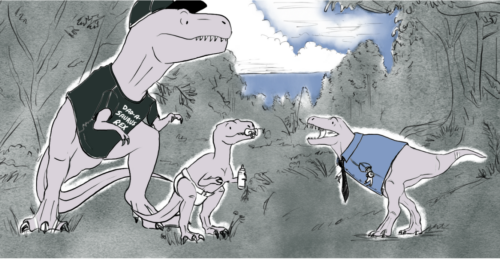
For over sixty years, a contentious debate divided the field
of dinosaurian taxonomy. Although considered a small
tyrannosaur, Nanotyrannus lancensis looms large in
paleontological debate. At the root of this feud lies the question:
is this specimen an entirely distinct taxon, or merely a baby
Tyrannosaurus rex?
For decades, experts gravitated towards the latter conclusion.
However, this consensus was entirely upended by a recent
study published in Science that used dinosaur bones from
Yale’s Peabody Museum. Using a novel methodology, a team
of researchers analyzed the presence of growth marks in the
ceratobranchial bone, a rodlike structure in the lower jaw of
N. lancensis. This new approach led to the discovery that N.
lancensis had reached skeletal maturity. One of the leaders
of the study was Christopher Griffin, a curatorial affiliate at
the Peabody and assistant professor in the Department of
Geosciences at Princeton. “Looking at the throat bone there, it
gave every indicator of being either mature or being very, very
close to mature. It would not have gotten much bigger,” Griffin
said. Contrary to the long-held belief, this Nanotyrannus was
not a baby T. rex, but an entirely different species.
The significance of such a finding goes further than settling a
decades-long dispute. Taxonomy is essential to understanding
extinction dynamics. “This is particularly important for the
time period that Tyrannosaurus and Nanotyrannus come
from because it’s at the very, very end of the age of dinosaurs,”
Griffin said. “So this is the last ecosystem to host non-bird
dinosaurs.” The identification of N. lancensis as a distinct
taxon raises additional questions about dinosaurian diversity.
Paleontologists are forced to face the question: What other tiny
taxa have been overlooked?