
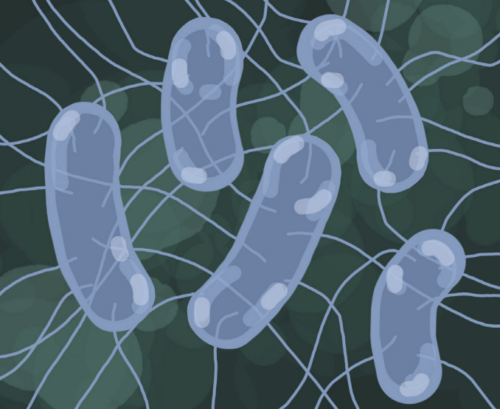
In the microscopic world, chemical signals are everywhere. As organisms seek out nutrients and flee from predators, they rely on invisible chemical gradients that ripple throughout their environments. For the single-celled prokaryote, Escherichia coli, survival depends on navigating this information-rich chemical landscape. However, new research suggests that E. coli can access only a fraction of the information in its environment, contradicting previous theories and upending the active research community at the intersection of physics, statistics, and biology.
Chemotaxis, the ability of cells to move in response to chemical stimuli, is a classic example of biological decision-making. E. coli swim using a “run-and-tumble” strategy: they barrel forward before stopping and reorienting. When the bacterium detects food, tumbling is suppressed, and it charges headlong. Notably, the bacterium does not measure absolute concentration—or rather, it can’t. Instead, it senses particles bumping into its receptors, counting collisions over time in order to infer changes in nutrient availability. Of course, this poses a statistical challenge: arrivals fluctuate, and signals can be inseparable from meaningless noise.
In the 1970s, a biologist named Howard Berg and a physicist named Edward Purcell calculated the physical noise floor imposed by random arrivals of molecules. Their framework established an upper bound on the accuracy with which a cell could estimate concentration. Scientists hypothesized that E. coli could incorporate nearly all of this information into its decision-making. “Everyone basically assumed that E. coli is operating at that bound of what is physically possible,” Thierry Emonet, professor in the departments of Physics and Molecular, Cellular, and Developmental Biology, said.
However, they couldn’t have been more wrong. In a recent study in Nature Physics, Yale researchers, including Emonet and Benjamin Machta, a professor in the Department of Physics, compared two quantities: the maximum information available to E. coli and the information actually encoded by the bacterium’s internal signaling pathway. Using a powerful imaging technique called Förster Resonance Energy Transfer, they monitored the activity of CheA, an enzyme that plays a central role in the chemotaxis network. This allowed the researchers to quantify how much information from the environment the organism processed.
The result was striking: E. coli encodes less than one percent of the theoretical information limit. “I found this surprising,” Machta said. “Chemotaxis and information are really important for survival, so it was natural to think they worked at near theoretical limits.” The dominant limitation is internal biochemical noise within the signaling cascade. Once a particle binds to the E. coli sensor, the resulting signal passes through a tangled array of biological circuitry, amplification, and motor control systems. Like making a call with bad cell reception, the signal gets garbled and degraded as it travels, destroying information.
But if E. coli is the optimized result of billions of years of evolution, why does it seem so bad at its job? “That suggests that there are other constraints that it evolved for,” Emonet said. Paradoxically, the noise generated by the chemotaxis network might actually help the bacterium. Being overly sensitive to the environment could make the bacterium’s movements too random and jerky. By first filtering the raw signal, E. coli stays directed and coordinated.
Perhaps most surprising is that despite encoding far less information than physics allows, E. coli still climbs gradients at roughly two-thirds of the theoretical maximum speed predicted from its information intake. “Information is very hard to get in this system,” Machta said. “But once you have it, you should use it.”
These results may extend far beyond bacteria. Any cell making decisions under uncertainty, from neurons integrating weak sensory inputs to immune cells detecting rare antigens, faces these same trade-offs. The methods that Machta, Emonet, and their team are using may open new avenues to understanding how biological systems balance precision, noise, and function. “It really does open so many avenues for research,” Machta said.
Rather than merely revealing biological limitations, this study provides a blueprint for future research. By comparing theoretical bounds with real-world performance, researchers can identify where constraints arise, thereby improving our understanding of sensory systems. As scientists gain more information, the mysterious world of biological sensing is becoming less uncertain.