
Who gets to shape the future of science? Some stories of science present a certain picture: a lone scientist in a lab, through an act of heroic ingenuity, makes an advancement that will go on to save lives or transform society. The reality is that innovation hardly ever occurs in a vacuum—science is a profoundly collective enterprise. Since modern science relies on an interdependent network of knowledge, progress arises when experimentalists and theorists exchange insight, when one researcher’s data validate another’s hypothesis, and when entire communities contribute to refining methods and standards. Discovery is iterative, self-correcting, and fundamentally communal.
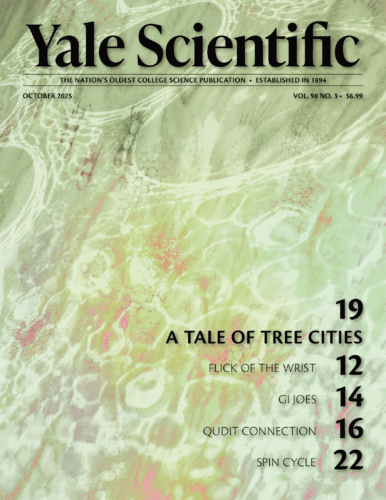
An exemplary case of the power of scientific collaboration comes from the work of Michel Devoret, a professor of applied physics at Yale. On October 7, the Royal Swedish Academy of Sciences awarded the 2025 Nobel Prize in Physics to Devoret and two colleagues for demonstrating quantum mechanical phenomena at a macroscopic scale in an electric circuit. In “Qudit Connection” (p. 16) Lynn Dai and Hannah Dirsa sit down with Devoret and postdoctoral researcher Benjamin Brock to discuss Devoret’s current work at the Yale Quantum Institute. Devoret’s prize-winning innovations came about after decades of incremental improvement in instrumentation, theory, materials, and methods, and the practical outcome for the future of quantum computing depends on a vast network of researchers, engineers, and institutions beyond the three Nobel laureates.
And progress also depends on the exchange of ideas across disciplinary boundaries. This issue’s cover story, “A Tale of Tree Cities” (p. 19), profiles a recent collaboration between Yale engineers and ecologists to bring light to the often-overlooked microbiomes of trees. The team’s work disrupts long-held assumptions about the microbes that call forests home. The surprising insights of this collaboration demonstrate how innovation flourishes when curiosity and cooperation bring distinct areas of expertise into conversation with each other.
This issue of the Yale Scientific Magazine is a testament to the teamwork that makes science possible. Whether the researchers we cover in this issue are revising the design of chemical reactors to scale up the recycling of plastics or uncovering the genetic causes of dementia, they are engaging in the global project that advances knowledge through the gradual accumulation of ideas in publicly accessible scientific reports. Our organization’s goal is to share recent scientific findings with the public in an accessible format, so we hope that you consider yourself a part of this worldwide conversation. This issue is the product of innumerable hours of work by nearly one hundred students at Yale, including thirty-five new contributors from the incoming Class of 2029.
Science is for everyone. The team behind the Yale Scientific Magazine hopes that these pages welcome you into the fold.