
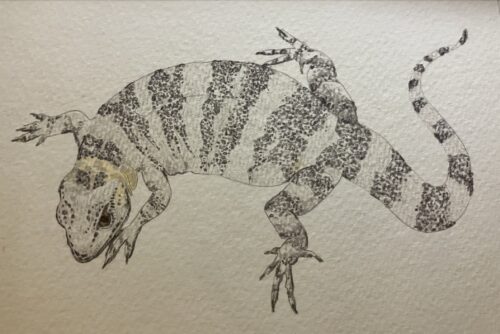
As habitats atrophy and ecosystems roast under a rapidly warming atmosphere, cold-blooded animals—species reliant on the external environment to regulate their body temperature—are at serious risk. A recent paper published by the Muñoz Lab at Yale investigates how three species of lizards native to Mexico, all passive thermoregulators, are responding to a warming world. They measured wild lizard body temperatures, first from 2003 to 2004 and then again from 2016 to 2018, comparing the data to experimentally determined preferred lizard body temperatures. This allowed the researchers to estimate how the thermoregulatory behavior of the three species had changed over a period of thirteen to fifteen years in response to increasing temperatures.
Three species were studied: Gerrhonotus liocephalus, the Texas alligator lizard; Xenosaurus rectocollaris, the pallid knob-scaled lizard; and Xenosaurus tzacualtipantecus, the Zacualtipan knob-scaled lizard. In each sampling period, researchers collected the immediate body temperatures of lizards in the wild, as well as their temperatures when allowed to move to their preferred temperature in a laboratory thermal gradient. The researchers hypothesized that the lizards would have partially increased their preferred temperatures between the first and second timepointsin an attempt to negate the adverse impacts of global warming on their biological behaviors. In other words, they would “learn to love” the higher heat.
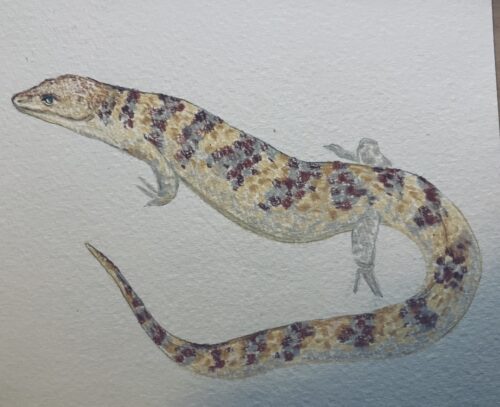
The results vindicated this hypothesis—the average preferred temperature of all three lizard species increased by an average of one degree Celsius over the study’s time period. However, this is only a temporary fix for these intrepid ectotherms. “There is a biological limit which animals cannot exceed,” said Saúl F. Domínguez-Guerrero, a postdoctoral associate in the Muñoz Lab and the first author of the study. “Some proteins can’t operate at very extreme temperatures.” This has dire implications for the futural survival of these species. As lizards increase their preferred temperatures, their metabolisms will also increase, amplifying the risk of starvation. Increased body temperatures also interfere with reproduction. If they become unable to obtain sufficient nutrition and bear healthy babies, Gerrhonotus and Xenosaurus may soon face the threat of extinction.
This existential threat appears to have been accelerated by environmental degradation. Between the two research trips, the scientists observed a marked decline in vegetative cover. “Even in the same environment, we observed a lot of shift in ten years, especially with habitat fragmentation,” Guerrero said. “Now it’s harder, if not impossible, to find lizards in exactly the same place where my colleague Guillermo started his project during 2003 […] I think in the next ten years, that population, at least in that particular place, could disappear.”
Species like G. liocephalus, X. rectocollaris, and X. tzacualtipantecus might entirely vanish before we even have the chance to understand exactly how global warming and human activity are imperiling them. It is of paramount importance to study how these delicate and wondrous creatures, endangered by a callous overuse of the natural world, are responding to their deteriorating environments. It is only with that knowledge that we’ll have a chance to save them.