
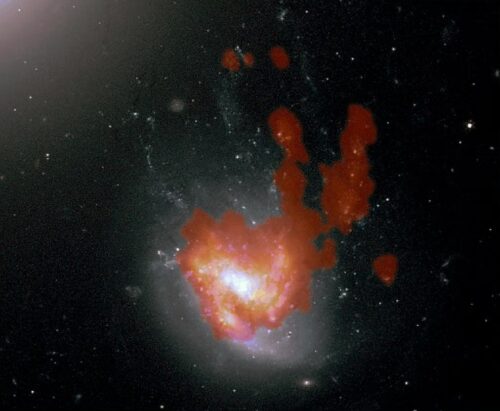
In the quest to understand how galaxies evolve, Yale astronomers studied NGC 4858, a “jellyfish galaxy” in the Coma Cluster more than three hundred million light-years away. The galaxy’s unique shape offers rare insight into ram pressure stripping, a process that can transform galaxies into “red and dead” systems that no longer form stars.
“Ram pressure is like a wind force—it’s ρv², density times velocity squared,” explained Jeffrey Kenney, a professor of astronomy at Yale. “In clusters, both density and velocity are high, so the force is thousands of times stronger than what the Milky Way feels in our small group.”
First author Harrison Souchereau, an astronomy graduate student at Yale, said the team was drawn to NGC 4858 because of its unusual gas structure, which features two large tails, or “bunny ears.” “It had one of the most interesting and unique looking gas distributions […] It wasn’t symmetrical whatsoever. That intrigued both of us,” Souchereau said.
Strong ram pressure can strip gas from galaxies, forming long tails reminiscent of jellyfish tentacles, such as NGC 4858’s bunny ears. Sometimes, the stripped gas does not escape but instead returns to the galaxy, a phenomenon called “fallback.” The researchers were able to find clear evidence of fallback in NGC 4858 using data from the ALMA radio telescope. “The fallback feature itself was very surprising when we saw it for the first time,” Souchereau said.
The consequences are profound. Cold gas is a necessary ingredient for star formation. “Once the gas is gone, the galaxy turns red and dead,” Kenney noted. But fallback can briefly revive star formation; in “jellyfish galaxies” like NGC 4858, researchers have observed young stars in the tails of stripped gas. “The fact that you see stars at all [in the stripped tails] is immediately quite surprising,” Souchereau said.
Future observations with the James Webb Space Telescope may shed light on the role of dust in these stripped galactic tails. Meanwhile, Souchereau is looking ahead. His next paper will build on the confirmation of fallback, probing just how rare it is for galaxies to recycle gas in such hostile cluster environments.