
Picture the conventional depiction of evolution: an ape walking on four limbs, a hunched hominin, and finally a straight-backed human. While convenient, this linear concept may no longer faithfully depict the evolution of modern humans. At Arizona State University’s Human Origins Institute, Kaye Reed and colleagues’ recent discovery is altering previous notions about human ancestry. The team proposes that instead of viewing human evolution as a linear process with temporally distinct steps, it should rather be regarded as a complex cloud of simultaneously-evolving species.
Lucy is a 3.2-million-year-old hominin whose discovery proved upright walking did not evolve synchronously with larger brains. Her species, Australopithecus afarensis, disappeared from the fossil record 2.95 million years ago, and it was not until two hundred fifty thousand years after that species in our genus, Homo, first appeared. Whether Homo diverged from A. afarensis was unknown, but the discovery made by Reed and her team may help to answer this question.
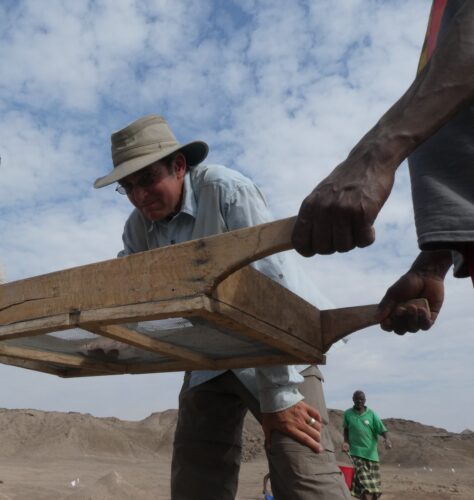
In 2013, Reed’s team started surveying near Lucy’s excavation site in Ledi-Geraru, Ethiopia. The team discovered a lower jaw from a species in the genus Homo (dated to 2.78 million years ago)—the oldest yet found! In the same year, they also discovered diverse collections of hominin teeth. By using dental specimens belonging to hominins of known species, uncategorized teeth were able to be identified. Differences in dental structure, shape, and size were run through analytical computer programs to compare physically miniscule, but evolutionarily significant differences. After being compared to dental specimens from ten different species, the team concluded that the teeth belonged to Australopithecus. This placed both A. afarensis and Homo in close temporal proximity. This began to fill the record’s gap!
Three years after this deduction, Reed’s team began to explore another nearby site. Even more dental specimens were found and compared to Lucy and the recently discovered Australopithecus teeth. The new set of teeth were different from the A. afarensis specimens and lacked structural similarities from Homo. This indicated the existence of another Australopithecus species, one that hadn’t yet been discovered—which finally filled the record’s gap!
The diversity of geographically and temporally close dental specimens implied the existence of multiple lineages in the region. Where it was once thought improbable, these specimens suggest the cohabitation of different species. “How did they divide up the landscape? Did they eat the same things? Did they share?” Reed asked. The team wondered how multiple organisms occupying the same niche could coexist. These uncertainties shape the future of Reed’s research.
What is certain is that evidence of the coexistence of these species rejects the linear model of evolution that is currently accepted. Rather, the history seems more convoluted, twisting, and asynchronous. “They can’t all be ancestors,” Reed said. As a result, it is possible that interbreeding occurred, resulting in hybridization in later generations. This may have introduced genetic variation and behavioral innovation. This adds to evidence of how scientists regard evolutionary relationships and ancestral histories of species, both alive and extinct.
In 2026, the team will return to the Ledi-Geraru field to continue pursuing novel hominin specimens and uncover more about the new Australopithecus species. As they search for additional parts of the whole, these recent findings and their implications will drive their explorations.