
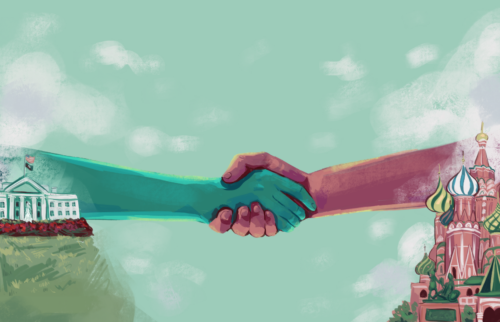
The Cold War, the period of immense competition between the victors of World War II, has always been a field of deep historical research. After all, it constitutes a unique case study in peace through deterrence, in arms races, and in “war” through proxy conflicts. The two superpowers, representing two distinct ideologies and seeking to preserve their influence on the global scene, sought to outmaneuver each other and dominate in every frontier possible. Naturally, the fields of science and technology were one of the key domains around which these rivalries revolved. In a race for survival, every success meant both a strategic advantage that could determine the outcome of a direct confrontation, and a boost in morale and prestige.
However, the discussion around science in the Cold War often focuses on the “races”—the race to develop the hydrogen bomb, the Space Race, the race amongst intelligence agencies. In truth, however, even in an era when one side viewed the other as absolute evil, scientific collaboration was not absent.
Historian of science Anna Doel at the American Institute of Physics has studied this initially counterintuitive phenomenon extensively and recently published an article in Physics Today offering a brief overview of the scientific exchanges between the two rivals.
In the beginning, collaboration was difficult and obstructed by bureaucratic and national security obstacles. Apart from the difficulty of identifying potential collaborators, scientists had to go through a lengthy vetting process to establish that any projects would not compromise US or Soviet national security and that the scientists would not end up defecting to the “enemy.” However, the death of Josef Stalin and the de-Stalinization movement initiated by Nikita Khrushchev allowed for greater academic freedom in the USSR, leading up to the 1958 Lacy–Zarubin agreement. This agreement allowed for academic exchanges between the two countries—a process that, despite tensions and the wars in Vietnam and Afghanistan, continued all the way through the end of the Cold War.
Of course, working together with citizens of the “enemy” came with its own difficulties, both on a practical and personal level. Working on potentially sensitive scientific research in the USSR drew the attention of domestic intelligence agencies, which occasionally even offered their “hospitality” to the American collaborators. At the same time, we must consider how (and if) the scientists themselves could ignore the conflict between their respective nations to collaborate effectively. “Science cannot exist in a vacuum,” Doel said. “It’s a social institution and human endeavor. It is unrealistic to think that humans who have to communicate will not be influenced by their political views, ideological affiliations, or just their emotions. So, you cannot stay fully detached from what’s happening in the world.”
But the very existence of these collaborations begs the question: Why would the sworn enemies agree to collaborate on a field that they both wanted—and needed—to dominate? According to Doel, there are three major reasons for this unexpected collaboration. The first is that science requires large and diverse data sets to draw meaningful conclusions. For example, a geologist from Washington cannot verify his hypotheses using specimens obtained only from North America, because that data set is limited and biased. Similarly, an astronomer requires access to telescopes around the globe to track the trajectory of an asteroid throughout the day. This necessity for access to scientific sites and data forced the two reluctant rivals to collaborate.
Another reason related to the Cold War itself. “It was important to find out what it was that the enemy nation was advancing in, which scientific disciplines,” Doel shared. The history of science reveals a long path, where each discovery serves as the foundation for further research. Consequently, scientists needed to know what the other side was working on to be able to draw on new results and implement them in their own work. And finally, there is the obvious factor of cost. “Even the wealthiest nation cannot afford to build all the equipment and staff all the facilities to produce top-notch research in all fields of the natural sciences,” Doel said. Especially in fields like particle physics, space research, or radio astronomy, collaboration is usually the only way to cover the extremely high costs related to the operation of facilities like CERN (the European Organization for Nuclear Research) or the International Space Station.
Today, scientific collaboration between the West and Russia has reached its lowest point—at least in the twenty-first century. Especially after the Russian invasion of Ukraine in 2022 and the imposition of sanctions by the United States and the European Union, Russian and American scientists are confronted with restrictions in travel, cuts in funding for multinational projects, and even the discontinuation of international partnerships on grounds of national security. At the same time, Russia is turning to the East—namely to China—to establish new relationships and obtain the aforementioned benefits without relying on the West. Even landmarks of scientific collaboration, like the International Space Station, are threatened by the potential withdrawal of Russian support.
Of course, collaboration can still happen, even under the most difficult circumstances. And Doel does believe that it is possible. “But a lot of factors that we may or may not think about at this point will have to play into that restoration, including motivations,” she said. Still, making predictions about the future, especially when we are so close chronologically to the events, is often not possible. We can only hope.
The field of the history of science lies at this interesting intersection. From an epistemological perspective, the history of science does not differ significantly from other genres of history—except, of course, in the sense that it studies the evolution of the natural sciences. “The history of science is no different from any other field of history in terms of research methods. It’s what you can expect: the archive, the published materials. In my case, I do use many other sources to inform myself of historical events, one of them being scientific literature,” she said.
At the same time, history shares some interesting similarities with the natural sciences. Even though one cannot perform reproducible experiments about the past, or have independent variables in a chaotic course of events, the methods employed by historians resemble the scientific method. “The archive and the experiment are similar,” Doel said. “As a historian, you go into the archive with a hypothesis, but also with your eyes wide open, knowing that you may or may not find what you look for. You may find something you weren’t looking for.”
The story of the Cold War’s scientific exchanges has a double salience. First, it highlights the international character of science and can be viewed as a beacon of hope for preserving the interconnected network of research and international projects. Second, it is an opportunity for those in the natural sciences to explore and acknowledge the benefits of exploring the history of science and learning from it, as we navigate a challenging geopolitical environment.