
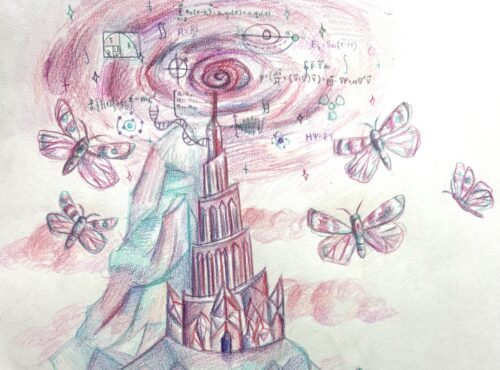
When you imagine a physicist, who comes to mind? Perhaps a mad scientist with frizzy hair, or a reclusive genius scribbling equations on a chalkboard. There is something romantic about this “eccentric physicist,” who pushes ahead into the intangible, the invisible, the unknown. Their work is incomprehensible to us, and their understanding of the universe is a reversal of our own. This image of an eccentric physicist has permeated our culture for centuries. But as public trust in science continues to diminish, this cultural conception may be doing more harm than good. It may be time to bring physics down from its cosmic heights by making it more accessible to the public.
Suspicion and Skepticism
Suspicions surrounding physics have existed since the beginning of human inquiry. In Ancient Greece, Anaxagoras was exiled from Athens for claiming the sun was an enormous, fiery ball, rather than a god. In medieval Europe, the heliocentric theories of Copernicus and Galileo were censored because they undermined the foundations of Christian doctrine. Even Einstein’s theory of relativity was initially rejected by some established academics. At every stage of scientific progress, physicists who challenged prevailing beliefs were met with skepticism, criticism, and often fear. Societies struggled to accept ideas that complicated, and in some cases entirely upended, their understanding of natural order. At the same time, it was only by daring to defy existing paradigms that physicists could shift our most fundamental notions about the universe.
This tension between creativity and heterodoxy has defined physics for centuries, and has only deepened over time. Steve Lamoreaux, the Eugene Higgins Professor of Physics at Yale, reflected on his experience growing up in the post-Cold War era—a time that highlighted the dual capacity of physics to inspire wonder and fear. Physicists helped put men on the Moon, but they also developed technology that could end hundreds of thousands of lives in a single nuclear blast. “I think it eroded public confidence in science […] we developed these things that we have no control over,” Lamoreaux said. Since then, public skepticism towards nuclear physics has only increased, and in parallel the frontiers of research in much of the field has become increasingly abstract—and increasingly removed from the public eye. “The nuclear threat is still there,” Lamoreaux said. “We just don’t talk about it anymore.”
The increasing complexity and abstraction of physics mean that practical applications often lag decades behind new discoveries. The invention of the laser, for instance, took decades to find its way into fiber-optic cables that now support the internet. For physicists like Lamoreaux, this delay makes discoveries not just difficult to explain but also challenging to justify. As a result, curious students often struggle to find meaning in material that is highly theoretical, and many end up turning away from physics altogether. Yet, the mysterious allure of physics continues to draw the public in, in spite of its opacity. From Sheldon Cooper investigating the intricacies of quantum mechanics to Doc Brown flying through time in his gray DeLorean, it’s hard to escape the childlike fascination that the subject evokes. Reconciling physics’ theoretical complexity with enduring intellectual intrigue is a challenge that physicists continue to face.
Who is a Physicist?
Bárbara Cruvinel Santiago, lecturer in the Department of Physics and Dean of Berkeley College at Yale, has spent much of her career studying the relationship between physics and society. After receiving her PhD, Cruvinel Santiago served as a Stanton Postdoctoral Nuclear Security Fellow at Stanford. When she discusses her technical work with others, she often struggles to shake off stereotypes and biases about the field fed by pop culture. “There are a lot of people who aren’t in physics who should be,” she said. Popular reception may be one factor that deters these individuals from considering physics in the first place. Cruvinel Santiago believes that the media should move beyond portrayals of physicists as bizarre experimenters and outlandish geniuses. “A lot of people in physics are just regular people like you and me,” she said.
It can be difficult for the public to see themselves in the researchers they admire. With its intense academic demands in undergraduate and graduate education, physics might end up isolating those with expertise from those on the outside. “There’s a whole different set of techniques in dealing with people than in dealing with oscilloscopes and cables […] that doesn’t really translate over,” Lamoreaux said. For both Lamoreaux and Cruvinel Santiago, the root of the problem is education. At the university level, it can be challenging to capture the excitement of creative experimentation while also teaching technical skills. Doing both at once requires skills that many physicists are never taught.“There’s very little training for physicists to communicate their research,” Cruvinel Santiago added.
Lamoreaux’s own physics inspiration began from tinkering with at-home experiments described in the Scientific American. That spirit of hands-on curiosity isn’t always reflected in the classroom. From his time as a student, Lamoreaux remembered proposing a creative solution to his teacher, only to be shut down. “[The professor] started yelling at me so loudly. [He said] there’s one way to solve this problem and we know how to do it,” Lamoreaux said. For a field that is propelled forward by innovative, out-of-the-box thinking, some physicists are ironically rigid. “People don’t want to have things different from what they learned when they were in graduate school. There’s an element of utility in that […] but on the other hand, there has to be a little bit of flexibility in ways to look at things,” Lamoreaux said. “That’s the way progress is made.” If that type of flexible thinking were more widely embraced in the physics community, physicists might not only be able to create new developments in the field, but also form closer connections with the public.
Physics and the Public
Though often overlooked, these connections are pivotal to scientific progress. Cruvinel Santiago put it simply: “If you don’t get the public to care about science, science funding gets lost.” Ironically, the backbone of science rests on the support of non-scientists. The people who make decisions about how much money is allocated towards scientific research are not scientists but politicians carrying out the priorities of their constituents. If the public does not believe science is valuable, politicians have little incentive to fund it.
Sometimes, building this relationship requires scientists to embrace the spirit of eccentricity. “Physics doesn’t provide a service, so it’s hard to assess use,” explained Lamoreaux, who chooses to demonstrate the appeal of physics in ways that aren’t strictly utilitarian. Four years ago, Lamoreaux appeared on NFL Countdown in front of an audience of two million sports fans to explain the physics behind a Seattle Seahawks play. Is this the most useful scientific communication ever made by the faculty of Yale’s Department of Physics? That’s up to you to decide. But does it get people invested? Most definitely.
Cruvinel Santiago shared a similar sentiment. “I feel like a lot of physicists have that tendency to use jargon just to make themselves sound smarter. And I think that’s not how we get the public to care about the stuff that we do,” she said. “That’s just how we alienate them.” The solution isn’t to make physics more intimidating, Cruvinel Santiago reasons, but to let the joy of the field show through. After all, scientific innovation is rooted in creativity and fun.
Bearing this in mind, the eccentric nature of physics becomes a double-edged sword. Wielded responsibly, it can spark scientific breakthroughs, inspire public investment, and sustain a thriving scientific community. Wielded irresponsibly, it alienates physicists and pushes everyone else away. For any physicist, learning to walk such a delicate line is its own challenging subject to master—one that’s every bit as important as the science itself.