
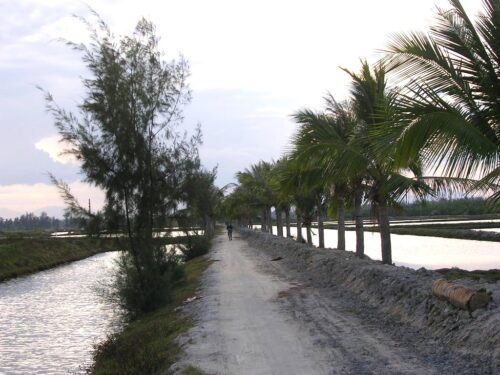
Levees are earthen embankments that comprise the most important part of America’s flood infrastructure, with over twenty-five thousand miles of levees around the nation and millions of people living behind them. Although levees are designed to protect communities against floods, they are not a guarantee. When a levee fails or a large torrent of water overtops it, the area behind becomes more vulnerable to flooding.
Historically underserved and socially vulnerable communities (HUSVCs) are overrepresented in the population that lives behind levees. The low-lying land behind levees is often less valuable, making it more affordable for HUSVCs to reside in these high-risk areas.
In 2023, the National Science Foundation (NSF) began allocating funding for Civil Infrastructure research for climate change Mitigation and Adaptation (CLIMA), which encompasses a range of projects that intend to improve civil infrastructure resilience while considering the risks and needs of communities.
Farshid Vahedifard, Louis Berger Chair of Civil and Environmental Engineering at Tufts University, performs work that aims to improve flood infrastructure in the face of changing climate extremes. His project, titled “CLIMA: Equitable Adaptive Strategies for Flood Protection Infrastructure under Current and Future Compound Hazards,” sought to ensure the stability of levee infrastructure against future climate conditions while accounting for the vulnerabilities of communities living behind levees. “We are proposing engineering solutions to address the resiliency of our aging infrastructure in the face of climate change, while integrating equity and justice,” Vahedifard said.
Many levees were built centuries ago by farmers and settlers seeking to protect their land against flooding, without considering their stability in the future. Vahedifard and his team utilize climate and hydrologic modeling to predict how climate change will impact future weather and precipitation patterns. They then employ geotechnical and structural engineering models and simulations to assess the current flood infrastructure’s ability to withstand these projected conditions. Lastly, they propose adaptation and hardening strategies to ensure the resiliency of levees in a changing climate. In their proposed adaptation strategies, they prioritize communities with lower adaptive capacities and limited access to resources, often due to pre-existing barriers. “[We] want to make sure you have something technically sound, practically feasible, economically viable, and, at the same time, socially just. We try to build this solution for each particular area, given the needs of the community,” Vahedifard said.
When designing adaptation strategies, Vahedifard incorporated various measures, including infrastructural, technological, institutional, cultural, and nature-based interventions. These involved structural changes, such as increasing the height of levees, as well as social measures, including increasing public awareness about flood risk and promoting more ecologically-friendly solutions. His team communicated with state agencies and local districts to understand the unique challenges that different communities across the country face when it comes to levee failure. So far, they have created a regional-scale model to estimate the probability of levee failure and a framework for determining the best adaptation strategies for each levee. Progress continues, but recent funding disruptions have slowed their work.
Cuts in NSF funding led to the termination of Vahedifard’s CLIMA project in April. Now, he has to turn to local sources of funding, which has caused delays in his research progress. He emphasized the difficulty of securing competitive grants for research and the considerable time and effort required for these projects and proposals. “The bulk of funding for research projects goes to education, to support PhD students and train the next generation of scientists and engineers,” Vahedifard said. Thus, the funding cuts affect not just the present but also the future of science, as opportunities for learning are becoming more scarce due to uncertainty and financial strain.
Despite these setbacks, Vahedifard emphasized that he will continue to actively pursue opportunities that allow for the continuation of this research. This effort is not being undertaken solely out of intellectual curiosity, but rather because of its social necessity and the need to protect vulnerable communities. “Over the years, I learned we need something beyond classic engineering solutions–we need to understand communities that are impacted by the performance of those levees,” Vahedifard said.
His passion and persistence in incorporating socioeconomic factors into engineering and infrastructure serve as an inspiration: scientists can apply their technical training towards solving social issues, simultaneously making the world both a more equitable and structurally sound place.