
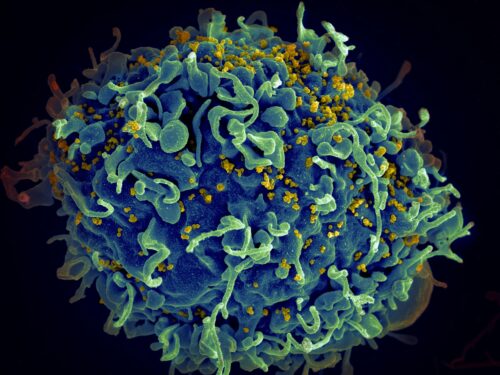
To establish lifelong infection, HIV-1 must cross one of the most secure borders in human biology: the nuclear envelope. Once inside, the virus integrates into the host genome, making it nearly impossible to eradicate without extremely early intervention. More than forty million people worldwide currently live with HIV, and despite major therapeutic progress, the exact molecular process that enables nuclear entry remains unresolved. Understanding that a single step could expose new therapeutic vulnerabilities and redefine how researchers approach curative strategies.
At the heart of the mystery is a physical paradox. The nuclear pore complex, a massive protein-based gateway that screens traffic in and out of the nucleus, has an estimated channel width around forty nanometers. The conical HIV-1 capsid, however, measures roughly sixty nanometers across, raising the long-standing question of how an object seemingly too large manages to pass through without disassembling prematurely. Even more puzzling, the capsid must remain adequately intact until it reaches the genome, since its disassembly outside the nucleus can halt infection entirely. The field has spent years attempting to reconcile these contradictory measurements with observed viral behavior.
Much of the difficulty stems from the complexity of the structure itself. The nuclear pore complex has been described as one of the most intricate machines in the cell, composed of more than thirty different proteins arranged into a dynamic, flexible gate. “The nuclear pore complex is the largest molecular machine in the body,” said Yong Xiong, professor of Molecular Biophysics and Biochemistry at Yale. Studying it directly in living cells is technically challenging, and isolating it intact is nearly impossible, which has slowed progress toward mapping precise viral-pore interactions.
Xiong and his collaborators approached the problem using an unconventional tool: DNA origami, a nanotechnology method that programs strands of DNA to fold into defined three-dimensional shapes. The group used this technique to construct artificial structures called NucleoPorins Organized by DNA (NuPODs), which mimic key structural and biochemical features of natural nuclear pores while remaining experimentally tunable. These synthetic pores allow researchers to adjust size, composition, and arrangement in controlled ways that would be impossible in living cells, enabling systematic testing of how the capsid responds to different pore architectures. Xiong likened these structures to designer nuclear pores.
Alongside NuPOD development, the research team engineered lab-built HIV-1 capsid assemblies that maintain essential biochemical behavior without requiring a fully infectious virus. Pairing synthetic capsids with programmable pores offered a way to reconstitute the process of nuclear entry outside the messy environment of the cell, which could reveal which capsid features enable passage and which pore properties block it. The team planned to confirm any discoveries using live-cell imaging to ensure that synthetic findings accurately reflected biological reality. “Modern science’s hallmark is collaboration,” Xiong said. The work united expertise in virology, structural biology, nanotechnology, and live-cell microscopy to tackle a question no single method could answer alone.
However, the federally funded project was recently cancelled while still in development, halting a rare mechanistic investigation at the point where it was poised to produce foundational insight. The implications of this cancellation extend beyond a single laboratory. Without NuPODs, researchers lose one of the first experimentally adjustable platforms capable of recreating nuclear import with fine molecular control. The loss may delay clarity on how HIV-1 maintains capsid integrity long enough to traverse the pore, a question tied directly to therapeutic opportunity. If scientists could determine which capsid conformations or interactions are essential for transit, future drugs might be designed to selectively destabilize or trap the capsid before it reaches the nucleus, complementing existing antiretrovirals rather than replacing them.
The cancellation also limits broader scientific potential. NuPODs could have become a transferable tool for studying other pathogens that manipulate nuclear transport, including hepatitis viruses, herpesviruses, and certain cancer-associated viruses. Beyond virology, nuclear transport malfunctions contribute to neurodegenerative disease, cellular aging, and some forms of immune dysfunction. A customizable synthetic pore system could have provided a platform for testing systems that remain inaccessible in living tissue.
Although progress has been interrupted, the conceptual groundwork and early technical advances continue to signal what may be possible. Research at the interface of nanotechnology and virology offers a path not only toward improved HIV therapy, but also toward a deeper understanding of the physical rules that govern life at the molecular scale. The story of HIV nuclear entry remains unfinished, and the questions raised by this project still stand: how does a virus bend biological limits, and how close are scientists to learning how to stop it?