
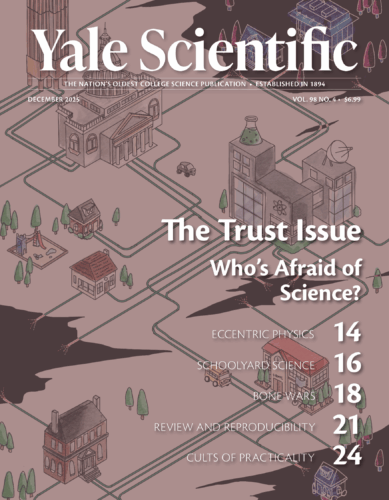
As Volume 98 of the Yale Scientific Magazine draws to a close, our team continues the annual tradition of focusing the final issue on a special topic. We cannot avoid the central fact of the year: 2025 has been a uniquely calamitous year for science research, science education, and science policy in the US. Across the sections of this print magazine and continuing on yalescientific.org, we chronicle a year of slashed budgets and silenced research, a year for which there are few historical precedents.
However, today’s turbulence is not the whole story. To focus only on this year’s shocks, even against the backdrop of national politics, would fail to capture the enormity of the present crisis. In this issue of the Yale Scientific Magazine, we investigate the crisis of public mistrust in science that extends far beyond just the recent onslaught of anti-science federal policies. We place this particular moment within a broader story where the relationships between individuals, science, and society have been negotiated and renegotiated over time. Who’s afraid of science, and why?
Science has always been a human institution entangled with questions of power, trust, and control over the truth. In “Bone Wars,” (p. 18) we learn of Yale’s fraught history of retaining human remains stolen for its collections under the banner of scientific research. “Review and Reproducibility” (p. 21) similarly considers how scientific institutions can enable corruption, oppression, and abuse, all in the context of experimental psychology research. These harms are real and unignorable. We highlight them in this issue to acknowledge what is at stake when scientists ask for trust.
Scientists’ voices take center stage in this special issue. In four interviews with researchers at the Yale School of Medicine and the Yale School of Public Health, we hear what funding cuts have interrupted and what they may erase (p. 12). With projects ranging from the development of an HIV vaccine to the remote identification of wartime human rights violations, the researchers show how far federal attacks on funding now reach. “A Heavenly Heresy” (p. 29) revisits a historical narrative of symbolic importance today. Though Hypatia of Alexandria cannot speak to us through the historical record, her canonization as a “scientific martyr” offers a lesson in the courage scholarship sometimes requires. This issue is an invitation to ask what we need scientists to do, and what culture that builds.
There is reason to be hopeful that scientific research in the US might fare better in the future than it did in 2025. Nonetheless, the lessons in this special issue of the Yale Scientific Magazine endure. Trust is not owed to science; it must be earned, repeatedly and continually. Scientists hold immense privilege and equally immense responsibility.