
Imagine sitting at a café, waiting for your order. As soon as your number is called, someone else gets to the counter faster than you to pick it up. Perhaps you think that the person misread their number on the receipt as the rationale behind this action. This scenario illustrates a cognitive function that many of us don’t think about but is instrumental to our lives—Theory of Mind (ToM), the ability to infer what people are thinking from their actions.
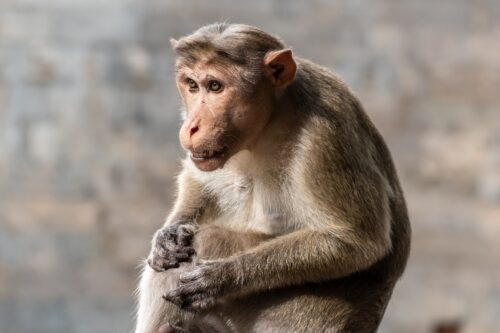
Many psychologists have often tested the ToM in different groups using false belief tasks, which evaluate the prediction of actions based on others’ false beliefs. Whether infants and primates succeed in false-belief tasks currently remains unclear. However, Amanda Royka, a PhD student in psychology, along with researchers in the lab of Yale professor Laurie Santos, conducted a study published in Cognition of 566 rhesus macaque monkeys at the Cayo Santiago Field Station in Puerto Rico to better understand the ToM capabilities of non-human primates.
Through four experiments, the researchers tested the monkeys’ ToM abilities by observing their reactions as a demonstrator searched for an apple in three boxes. In the first experiment, they familiarized the monkeys with a scene of an apple between two boxes alongside a third irrelevant box. The monkeys and the demonstrator observed the scene as the apple entered one of the boxes it was originally between. The demonstrator’s view was then blocked as the apple returned to its original box, creating a false belief. In the second experiment, the apple’s movement was repeated, blocked from the demonstrator’s view, and the demonstrator stared at the irrelevant box before looking into the relevant but empty box. In the third experiment, the demonstrator clearly saw the empty, irrelevant box prior to the apple’s movements, recreating the false belief from the first experiment. The fourth experiment repeated the first, but with the demonstrator knowing all the apples’ movements.
The lack of surprise in the monkeys in the first three experiments supports the “no prediction account”: the idea that these tasks are difficult for primates because they lose all expectations once another’s mental state does not coincide with reality. The fourth experiment revealed that the monkeys were surprised when the demonstrator, who knew the apple’s movements, looked into the irrelevant box. Accurate knowledge was key in predicting others’ actions. This observation not only provides better insight into the thought processes of monkeys but also suggests potential similarities between non-human primates and humans. “I like to think of my research as poking at what might be the foundation of how we developed this capacity because our capacity for ToM had to come from somewhere. […] It would be really interesting if it turns out that infants show the same error patterns as non-human primates,” Royka said. Perhaps this is the truth behind understanding our perceptions of others’ actions, which could change the way we see ourselves.