
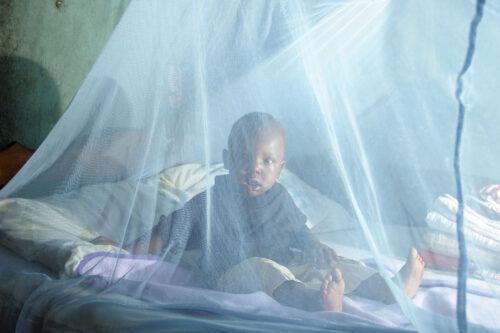
For decades, the fight against malaria has targeted its chief carrier: the mosquito. Throughout the twentieth century, epidemiologists advocated ambitious public health campaigns against mosquitoes, leading to the widespread use of powerful insecticides. The most popular was dichlorodiphenyltrichloroethane (DDT). However, DDT was eventually discovered to have devastating environmental and health impacts, resulting in its widespread discontinuation. In the meantime, mosquitoes had already gained resistance to the poison. Now, epidemiologists are forced to handle malaria with greater nuance. By gaining a deeper understanding of the environmental causes of malaria, scientists can develop safer tools to fight it.
Research has already established a link between climate change and malaria: as tropical environments become hotter and more humid, mosquitoes thrive. However, a new study in Nature led by Tasmin Symons and Peter Gething of the Malaria Atlas Project suggests a much more complex relationship. Using a rigorous statistical approach, their team measured the confounding interactions among climate, malaria, and socioeconomic factors in Africa. Then, they modeled how growing populations, shifting economies, and accelerating climate change might ripple through the disease landscape.
To build their model, Symons and Gething first fit a baseline system using twenty-five years of malaria data across forty-one African countries. Malaria is transmitted from mosquito to human by the Plasmodium falciparum parasite. Therefore, the scientists used the P. falciparum parasite rate (PfPR) as their core measurement of malaria prevalence. The authors transformed climate variables into two biologically useful indices: temperature suitability and larval habitat suitability, thereby explicitly linking climate conditions to mosquito ecology. Additional factors influencing malaria risk were incorporated through geospatial estimates of permanent larval habitat, housing quality, insecticide-treated net coverage, indoor residual spraying, seasonal malaria chemoprevention, and access to effective treatment. What distinguishes Symons and Gething’s approach from other models is its integration of immediate disruptive climate events and longer-term recovery dynamics, enabling the model to capture how extreme weather can temporarily weaken malaria control systems rather than merely altering ecological conditions.
These new considerations proved crucial. Symons and Gething found that extreme weather events, such as flooding and cyclones, accounted for roughly eighty percent of climate-attributable malaria cases. This finding reverses the common assumption that climate change influences malaria primarily through ecological changes. During natural disasters, reduced access to effective malaria treatment emerged as the largest contributor to the spread of malaria.
This result underscores the need for public health infrastructure equipped to control malaria in the aftermath of severe storms and other climate catastrophes. “When translated into impact on clinical incidence and deaths over the coming decades, the implications of climate change become substantial,” says Symons. Researchers at the Yale School of Public Health have reached a similar consensus, with leading experts such as Dr. Sunil Parikh acknowledging the multifaceted nature of tackling malaria. “We have to throw the kitchen sink at [it]…when you have multiple interventions out there, it protects the progress that we’re making,” Parikh said.